If solar panels are the heart of your solar system, the inverter is the brain. It converts the DC electricity from your panels into the AC electricity your home uses, and it determines how efficiently your system operates, how well it handles shading, and how much data you can monitor.
In the residential solar market, two companies dominate the inverter space: Enphase and SolarEdge. Together, they account for over 80 percent of the U.S. residential inverter market. Both are excellent — but they work differently, and the right choice depends on your specific situation.
This guide compares them across every dimension that matters.
How They Work: Fundamental Architecture Differences
Enphase: Microinverters
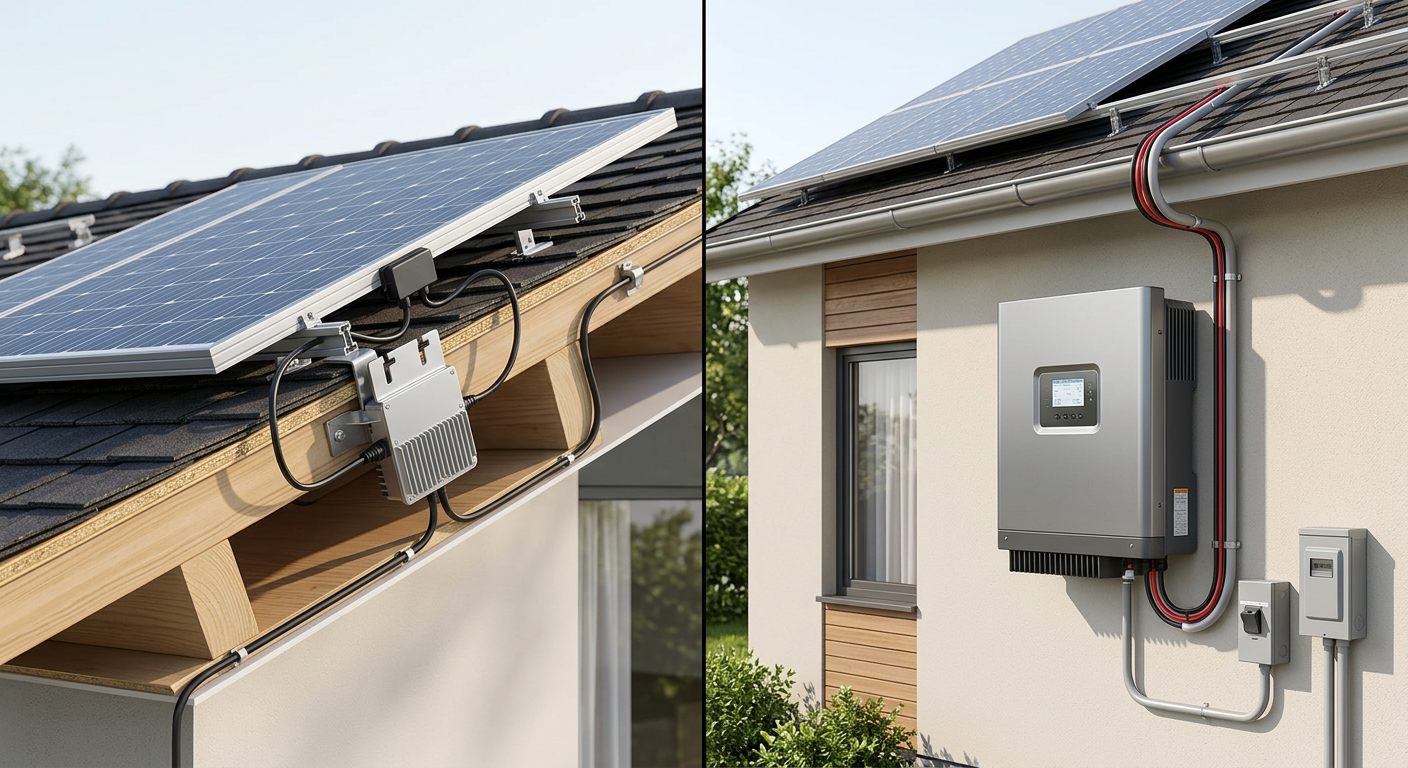
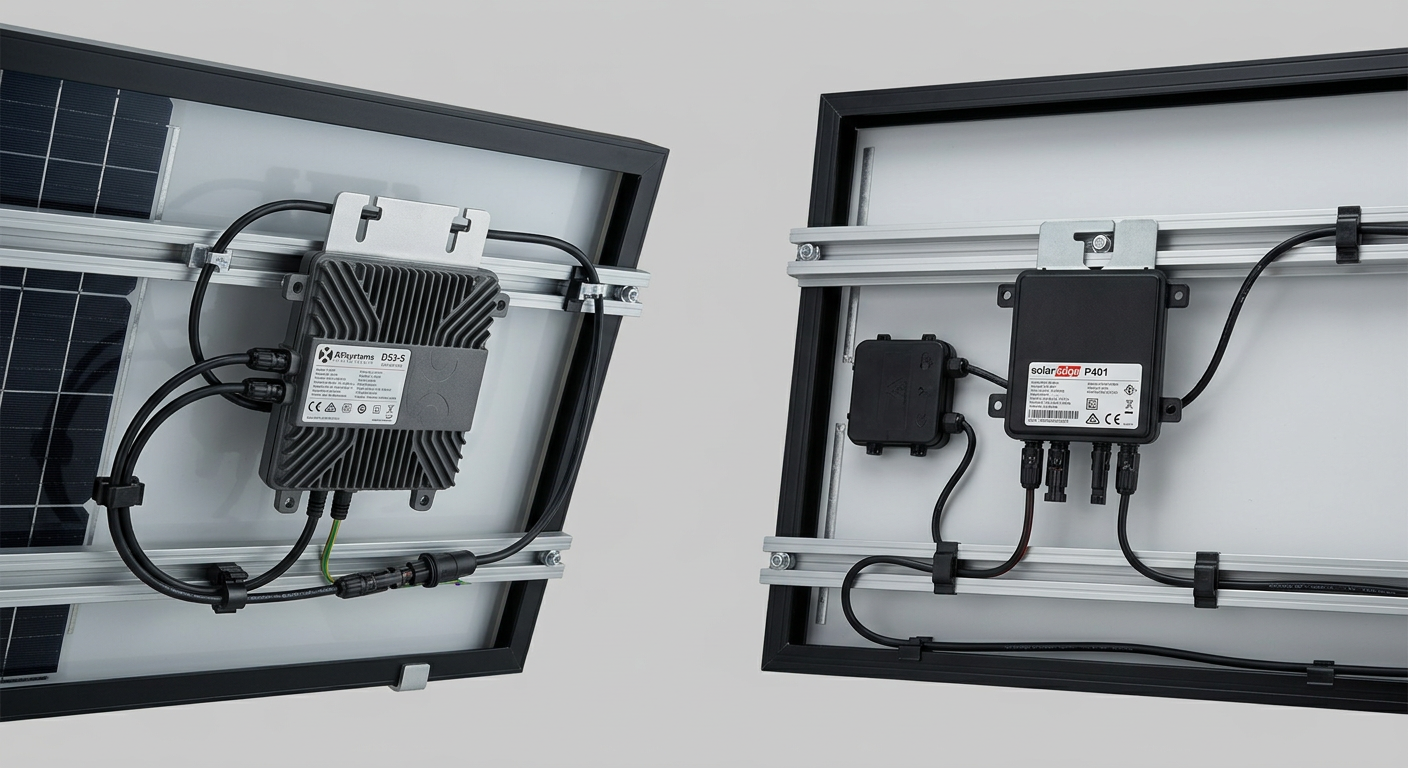
Enphase uses microinverters — small, individual inverters attached to each solar panel. Each panel has its own dedicated microinverter that converts DC to AC right at the panel. The AC electricity then flows directly to your electrical panel.
Current model: Enphase IQ8 Series
Key principle: Complete independence. Each panel operates as its own self-contained power plant. If one panel or microinverter fails, every other panel continues producing at full capacity.
SolarEdge: Power Optimizers + Central Inverter
SolarEdge uses a two-component system. Power optimizers are attached to each panel (like microinverters), but they do not convert DC to AC. Instead, they condition and optimize the DC voltage from each panel. The optimized DC electricity then flows to a central string inverter mounted on a wall (typically next to your electrical panel), where the DC-to-AC conversion happens.
Current models: SolarEdge Home Hub Inverter + S-Series Power Optimizers
Key principle: Panel-level optimization with centralized conversion. Each panel is individually optimized, but the heavy lifting of DC-to-AC conversion happens at a single, powerful inverter.
Performance Comparison
Shade Handling
Both systems handle shading far better than traditional string inverters, which drag the entire string down to the level of the weakest panel.
Enphase: Each panel operates completely independently. A shaded panel produces less electricity, but it has zero impact on any other panel. The unshaded panels continue at full output.
SolarEdge: The power optimizer on each panel maintains the optimal operating point regardless of shading. However, the DC current still flows through a string to the central inverter, which has a minimum operating voltage. In heavy shading scenarios where many panels are affected, the string may underperform slightly compared to independent microinverters.
Verdict: Enphase has a slight edge in heavy shading scenarios. For most real-world situations (partial shading on a few panels), both perform comparably.
Efficiency
Enphase IQ8 Series: 97.0% peak efficiency (CEC weighted efficiency approximately 96.5%)
SolarEdge Optimizers + Inverter: Optimizers operate at up to 99.5% efficiency. The Home Hub inverter achieves 99.2% peak efficiency. Combined system efficiency is approximately 98.5% CEC weighted.
Verdict: SolarEdge has a slight efficiency advantage on paper (about 1-2%). In real-world conditions, the difference translates to roughly 1-2% more energy production per year — a minor but measurable advantage for SolarEdge on unshaded roofs.
Multi-Orientation Roofs
Many Colorado homes have panels facing different directions (south and west, for example). The systems handle this differently:
Enphase: Each microinverter operates independently, so panels on different orientations naturally optimize themselves without any special configuration.
SolarEdge: Panels on different orientations can be wired into separate strings, each optimized independently. The power optimizers ensure each panel produces its maximum regardless of orientation. SolarEdge also supports uneven string lengths, providing design flexibility.
Verdict: Both handle multi-orientation roofs well. Enphase is slightly simpler in design; SolarEdge is equally effective with proper system design.
Reliability and Warranty
Enphase
- Warranty: 25 years on all IQ8 microinverters
- No single point of failure: If one microinverter fails, only that one panel is affected. The rest of your system continues producing normally.
- Mean Time Between Failures (MTBF): Over 300 years per unit (statistical reliability metric)
- Replacement: A failed microinverter is replaced individually — a 30-minute job for a technician
SolarEdge
- Optimizer warranty: 25 years
- Inverter warranty: 12 years standard, extendable to 20 or 25 years (additional cost of $500-$800)
- Single point of failure: The central inverter. If it fails, your entire system stops producing until it is repaired or replaced. Optimizers are individually redundant.
- Inverter lifespan: Typically 10-15 years for the central inverter unit
- Replacement: A failed inverter requires a service call to replace the entire central unit ($1,500-$3,000 if out of warranty)
Verdict: Enphase wins on reliability architecture. No single point of failure and a 25-year warranty on every component provide superior long-term peace of mind. SolarEdge's central inverter is a vulnerability — it will likely need replacement once during the system's 25-year life unless you purchase the extended warranty.
Monitoring and Smart Features
Enphase Enlighten
Enphase's monitoring platform is widely considered the industry's best:
- Panel-level monitoring: See the production of each individual panel in real time
- Consumption monitoring: Track your home's energy consumption alongside production
- Mobile app: Intuitive, well-designed iPhone and Android apps
- Alerts: Automatic notifications if a panel or microinverter underperforms
- Historical data: Detailed production history by hour, day, month, and year
- System health diagnostics: Remote troubleshooting capabilities
- Grid services: Participation in utility demand response programs
SolarEdge mySolarEdge
SolarEdge also offers comprehensive monitoring:
- Panel-level monitoring: Individual panel production data via the optimizers
- Consumption monitoring: Available with an optional energy meter
- Mobile app: Functional, though some users find it less intuitive than Enphase
- Alerts: Email notifications for system issues
- Historical data: Good production history and analytics
- EV charging integration: SolarEdge offers integrated EV charging inverters
- Smart energy features: Automated device management and energy scheduling
Verdict: Enphase Enlighten is generally considered the superior monitoring platform — more intuitive, more detailed, and more reliable. SolarEdge monitoring is adequate but receives more user complaints about app reliability and data accuracy.
Battery Integration
Both systems integrate with battery storage, but the approaches differ.
Enphase IQ Battery
- Modular design: 3.36 kWh or 5.04 kWh per unit, stackable up to 80 kWh
- AC-coupled: Works with any solar system (even non-Enphase)
- Seamless integration with Enphase microinverters and Enlighten monitoring
- 10 to 15-year warranty
- No single point of failure — modular battery units operate independently
SolarEdge Home Battery
- Available in 9.7 kWh and 23.2 kWh capacities
- DC-coupled: Directly connected to the SolarEdge inverter, which is slightly more efficient for solar-to-battery charging
- Integrated into the SolarEdge ecosystem
- 10-year warranty
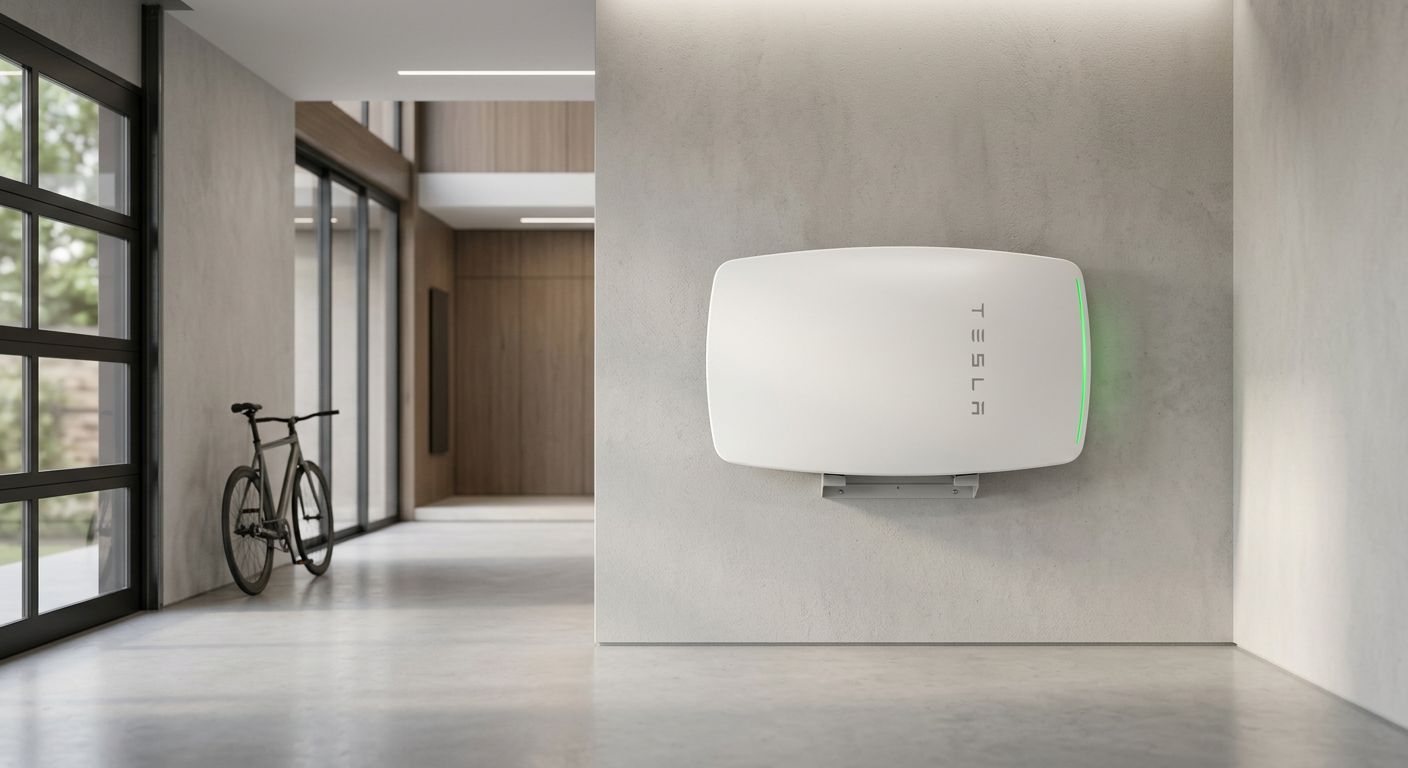
- Works with Tesla Powerwall as well (AC-coupled option)
Verdict: SolarEdge's DC-coupling is slightly more efficient for solar-to-battery-to-home pathways. Enphase's modular approach offers more flexibility in sizing and superior redundancy. Both are excellent options. If you are using Enphase microinverters, the Enphase IQ Battery is the natural pairing. If using SolarEdge, their home battery or a Powerwall integrates well.
Cost Comparison
Pricing varies by market and installer, but here are typical cost differences for a 7 kW system in Colorado:
| Component | Enphase | SolarEdge |
|---|---|---|
| Inverter/microinverter cost | $2,800 - $3,500 | $2,000 - $2,800 |
| Installation complexity | Slightly more (individual units) | Moderate |
| Extended warranty needed? | No (25-year standard) | Recommended ($500-$800) |
| Total inverter system cost | $2,800 - $3,500 | $2,500 - $3,600 |
When you factor in SolarEdge's recommended extended warranty, the total cost is comparable. Enphase is typically $300 to $700 more before warranties, but roughly equivalent when long-term warranty costs are considered.
For total system pricing including panels, see How Much Do Solar Panels Cost in Colorado?.
When to Choose Enphase
Enphase microinverters are the better choice when:
- Your roof has shading issues. Partial shading from trees, chimneys, or neighboring structures affects some panels. Enphase minimizes the impact.
- Your roof has multiple orientations. Panels on south, east, and west faces all need to operate independently. Enphase handles this effortlessly.
- Reliability is your top priority. No single point of failure means no total system outages.
- You want the best monitoring. Enphase Enlighten is the gold standard.
- You want a 25-year warranty on everything. No extended warranty purchase required.
- You plan to expand your system later. Adding panels and microinverters to an Enphase system is simple — just plug in additional units.
- You are pairing with Enphase IQ Battery. The all-Enphase ecosystem provides the most seamless integration and monitoring.
When to Choose SolarEdge
SolarEdge is the better choice when:
- Your roof is unshaded and single-orientation. On an unshaded south-facing roof, SolarEdge's slight efficiency advantage delivers the most energy per dollar.
- You want to minimize upfront cost. SolarEdge's base system cost is slightly lower.
- You want an integrated EV charger. SolarEdge offers inverters with built-in EV charging capability.
- You are pairing with a DC-coupled battery. The SolarEdge Home Battery's DC-coupling is slightly more efficient than AC-coupled alternatives.
- Your system is relatively large. For systems above 10 kW, SolarEdge's central inverter architecture can be more cost-effective.
ProGreen Solar's Recommendation
We install both Enphase and SolarEdge and recommend each based on the homeowner's specific situation. That said, our data shows that Enphase microinverters deliver superior long-term customer satisfaction for most Colorado residential installations. Here is why:
- Colorado roofs are complex. Most homes have multiple roof planes, varying orientations, and some shading. Enphase handles this complexity effortlessly.
- Reliability. Over hundreds of installations, we have seen fewer service calls and higher customer satisfaction with Enphase systems.
- Monitoring. Our customers overwhelmingly prefer the Enphase Enlighten app for its clarity and reliability.
- 25-year warranty. The full 25-year warranty on every microinverter, with no extended warranty purchase needed, provides the strongest long-term protection.
That said, for certain homes — large, unshaded, single-orientation roofs where maximum efficiency at the lowest cost is the priority — SolarEdge is an excellent choice.
The best approach is to discuss both options with a ProGreen Solar consultant who can evaluate your specific roof and recommend the optimal inverter technology for your situation.
Make Your Decision with Confidence
Both Enphase and SolarEdge are premium, industry-leading technologies. You cannot go wrong with either. The differences between them are relatively minor compared to the massive benefit of going solar in the first place.
Get your free solar consultation or call ProGreen Solar at (303) 484-1410. We will assess your roof, discuss both inverter options, and recommend the technology that delivers the best performance for your specific home.