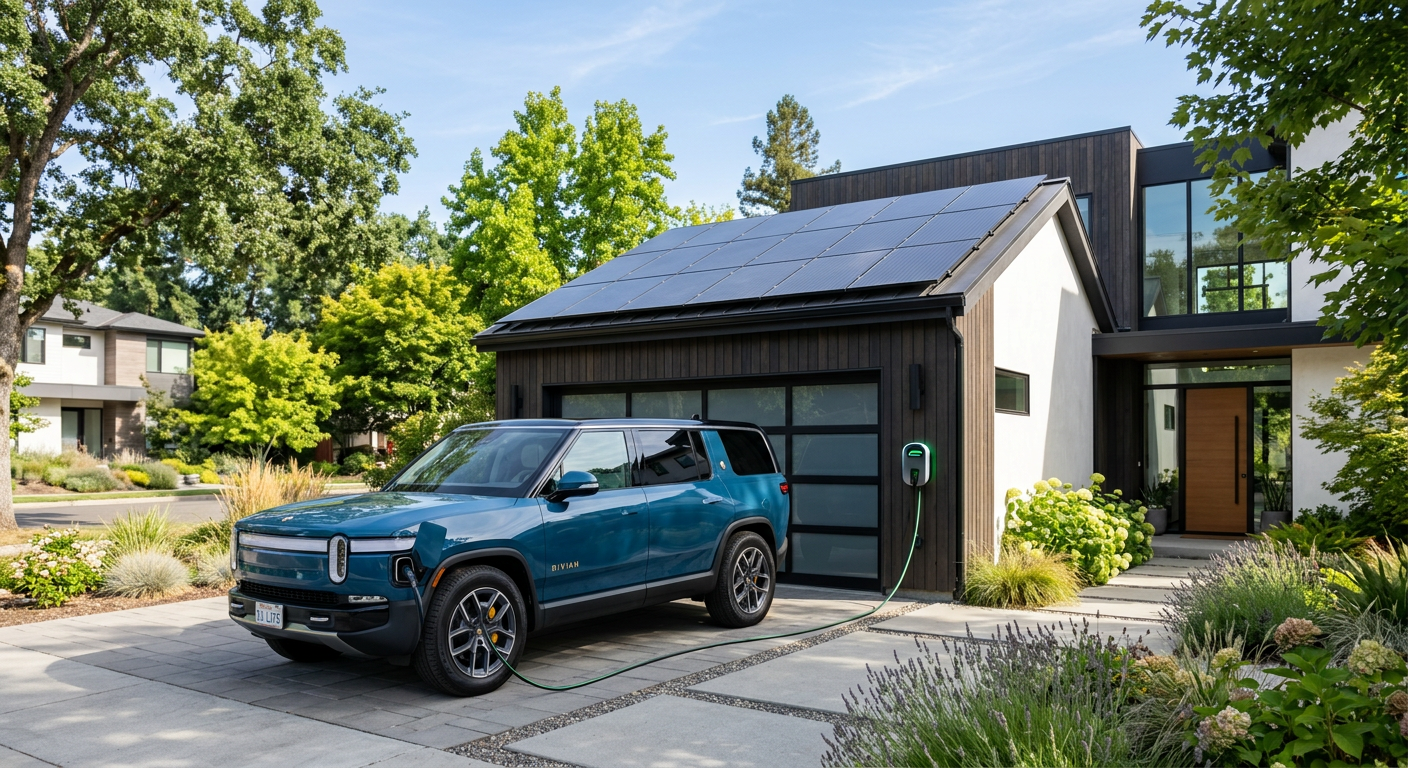
The combination of solar panels and an electric vehicle is one of the most powerful personal finance moves available today. You eliminate two bills — electricity and gasoline — by generating your own fuel from your roof. The savings are substantial: a typical Colorado household with an EV and solar saves $1,500 to $2,500 per year compared to grid-charged EV driving, and $2,500 to $4,000 per year compared to gasoline.
At ProGreen Solar, we are seeing explosive growth in combined solar-plus-EV installations. More than 40 percent of our new solar customers either already own an EV or plan to purchase one within two years. This guide covers everything you need to know about sizing solar for EV charging, choosing the right equipment, and maximizing your savings.
How Much Electricity Does an EV Use?
The first step in planning a solar-plus-EV system is understanding how much energy your electric vehicle actually consumes. EV efficiency is measured in kWh per 100 miles, and it varies significantly by vehicle:
| Vehicle | Efficiency (kWh/100 mi) | Annual kWh (12,000 mi) | Annual kWh (15,000 mi) |
|---|---|---|---|
| Tesla Model 3 | 25 | 3,000 | 3,750 |
| Tesla Model Y | 28 | 3,360 | 4,200 |
| Chevy Equinox EV | 30 | 3,600 | 4,500 |
| Ford Mustang Mach-E | 33 | 3,960 | 4,950 |
| Rivian R1S | 35 | 4,200 | 5,250 |
| Hyundai Ioniq 5 | 29 | 3,480 | 4,350 |
The average EV driven 12,000 to 15,000 miles per year consumes 3,000 to 5,000 kWh annually.
To put that in perspective, the average Colorado home consumes about 10,000 to 12,000 kWh per year for everything else. Adding an EV increases your electricity consumption by 25 to 45 percent — a significant load that your solar system needs to account for.
Level 1 vs Level 2 vs DC Fast Charging
Level 1 Charging (120V Standard Outlet)
Level 1 charging uses the portable charger that comes with most EVs, plugged into a standard 120-volt household outlet.
- Charging speed: 3 to 5 miles of range per hour
- Overnight charge (10 hours): 30 to 50 miles
- Best for: PHEVs, short commutes under 30 miles daily, secondary vehicles
- Cost: Free (uses existing outlet)
- Efficiency: 80 to 85 percent (more energy lost as heat due to slower charging)
Level 1 charging works for drivers who travel fewer than 40 miles daily and can plug in for 10 or more hours. For most EV owners, it is too slow to be practical as a primary charging method.
Level 2 Charging (240V Dedicated Circuit)
Level 2 is the standard for home EV charging. It uses a 240-volt circuit — the same voltage as your dryer or oven — with a dedicated EV charging station (EVSE).
- Charging speed: 12 to 44 miles of range per hour (depends on amperage)
- Overnight charge (8 hours): 100 to 350 miles
- Best for: All EVs, daily drivers, anyone who wants full flexibility
- Cost: $500 to $800 for the charger, $300 to $1,500 for installation
- Efficiency: 88 to 92 percent
Level 2 is what we recommend for virtually all EV owners. An overnight charge replenishes a full day's driving and then some, giving you complete freedom from public charging stations.
DC Fast Charging
DC fast charging is primarily for public charging stations and road trips. It delivers 100 to 300 miles of range in 20 to 45 minutes but costs $0.30 to $0.50 per kWh — three to four times more than home charging with solar.
For daily driving, home Level 2 charging with solar-generated electricity is far more economical.
Sizing Your Solar System for EV Charging
When designing a solar system that includes EV charging, we add the EV's annual consumption to your household consumption:
Total system size = (Home kWh + EV kWh) / Annual production per kW
In Colorado, a well-oriented solar system produces approximately 1,500 to 1,700 kWh per installed kW per year. Here is how the math works for a typical scenario:
| Component | Annual kWh |
|---|---|
| Home consumption | 10,500 |
| EV consumption (Tesla Model Y, 12,000 mi) | 3,360 |
| Total | 13,860 |
System size needed: 13,860 / 1,600 = 8.7 kW
Without the EV, this home would need only a 6.6 kW system. The EV adds approximately 2.1 kW of solar capacity — about 5 to 6 additional panels and $4,400 to $6,300 in system cost before the federal tax credit.
After the 30 percent ITC, the incremental cost for EV solar charging capacity is about $3,100 to $4,400. That investment generates $600 to $900 per year in electricity savings for your EV, yielding a payback of 3.5 to 7 years — before accounting for gasoline savings.
The Savings Breakdown: Solar EV vs Gasoline
Let us compare the annual fueling costs across three scenarios for a vehicle driven 12,000 miles per year:
Scenario 1: Gasoline Vehicle
- Fuel efficiency: 28 MPG (average car)
- Gas price: $3.50 per gallon (Colorado average)
- Annual fuel cost: $1,500
Scenario 2: EV Charged from the Grid
- Efficiency: 30 kWh per 100 miles
- Electricity rate: $0.14/kWh
- Annual charging cost: $504
- Savings vs gasoline: $996 per year
Scenario 3: EV Charged from Solar
- Efficiency: 30 kWh per 100 miles
- Solar electricity cost: $0.04-$0.06/kWh (amortized system cost)
- Annual charging cost: $144 to $216
- Savings vs gasoline: $1,284 to $1,356 per year
- Savings vs grid charging: $288 to $360 per year
Over 10 years, solar-powered EV driving saves $12,840 to $13,560 compared to gasoline — and that does not account for rising gas prices. If gasoline increases at 3 percent annually (its historical average), 10-year savings exceed $15,000.
Best Level 2 EV Chargers for Solar Homes
We recommend these Level 2 chargers for solar-integrated homes:
Tesla Wall Connector
- Best for: Tesla owners
- Power: Up to 48 amps (11.5 kW)
- Features: WiFi connected, load sharing for multiple Tesla vehicles, solar charging mode via Tesla app
- Price: $475
The Tesla Wall Connector integrates seamlessly with Tesla Powerwall and Tesla solar systems, allowing you to prioritize solar-generated electricity for EV charging.
Emporia EV Charger
- Best for: Budget-conscious buyers who want solar integration
- Power: Up to 48 amps (11.5 kW)
- Features: Solar surplus charging mode, energy monitoring, WiFi, app control
- Price: $500 to $600
Emporia's charger can modulate charging speed based on available solar production — charging faster when the sun is shining bright and slowing or pausing when production drops.
ChargePoint Home Flex
- Best for: Non-Tesla owners wanting premium features
- Power: Adjustable 16 to 50 amps
- Features: WiFi, scheduling, Alexa/Google integration, ENERGY STAR certified
- Price: $700
Enphase IQ EV Charger
- Best for: Homes with Enphase solar systems
- Power: Up to 40 amps (9.6 kW)
- Features: Integrates with Enphase IQ ecosystem, solar-aware charging, load management
- Price: $1,200 to $1,500
The Enphase charger is the premium choice for Enphase solar customers. It communicates directly with your microinverters and battery to optimize charging based on solar production, battery state, and grid conditions.
Smart Charging Strategies
The way you charge your EV matters almost as much as what equipment you use. Here are strategies that maximize savings:
Solar Surplus Charging
The simplest strategy: charge your EV only when your solar panels are producing excess electricity (more than your home is consuming). This ensures every kWh going into your car is free, solar-generated electricity.
Most smart chargers and solar monitoring systems can automate this. The Enphase and SolarEdge ecosystems both support solar-aware EV charging.
The tradeoff is that surplus charging is weather-dependent and may not fully charge your battery on cloudy days. Most drivers pair surplus charging with scheduled overnight charging as a backup.
Time-of-Use Optimization
If you are on an Xcel Energy TOU plan, schedule EV charging during off-peak hours (typically 9 PM to 3 PM) when rates are lowest. Combined with solar, this means:
- Daytime: charge directly from solar production
- Overnight: charge from the grid at the cheapest rate ($0.06 to $0.09/kWh)
- Never charge during peak hours ($0.18 to $0.28/kWh)
A well-optimized TOU charging schedule saves $200 to $400 per year compared to charging at random times.
Battery-Buffered Charging
If you have a solar battery system, you can store solar energy during the day and charge your EV overnight from the battery. This provides the most consistent solar-powered charging regardless of when you plug in.
A 13.5 kWh battery can provide 40 to 50 miles of EV range per cycle — enough for most daily commutes. The EV charges overnight from the battery, and the battery recharges from solar the next day.
Electrical Panel Considerations
Adding Level 2 EV charging to a solar home requires careful electrical planning. A 48-amp Level 2 charger needs a 60-amp circuit, which can strain older electrical panels.
Panel Capacity Assessment
Many Colorado homes built before 2000 have 100 to 150-amp main panels. Between solar (30 to 40 amps for the inverter), EV charging (40 to 60 amps), and existing household loads, you may exceed your panel's capacity.
Solutions:
-
Smart load management — Devices like Span panels or DCC-9 load centers can dynamically share capacity between your solar inverter, EV charger, and household loads without upgrading the main panel. Cost: $200 to $500.
-
Panel upgrade — If your panel is genuinely too small, upgrading to a 200-amp panel costs $2,000 to $4,000. This is often bundled with the solar installation for efficiency.
-
Lower-amperage charger — A 24-amp or 32-amp Level 2 charger requires a smaller circuit and still charges most EVs fully overnight. You sacrifice charging speed but avoid panel constraints.
At ProGreen Solar, we assess your electrical panel capacity during every site survey and design a system that accommodates both solar and EV charging within your existing infrastructure whenever possible.
Two-EV Households
Colorado has one of the highest rates of two-EV households in the country, and the trend is accelerating. If your household has or plans to have two electric vehicles, the solar sizing changes significantly:
| Scenario | Annual EV kWh | Additional Solar Needed | Additional Cost (Net) |
|---|---|---|---|
| One efficient EV | 3,000-3,500 | 1.9-2.2 kW | $2,700-$3,300 |
| One large EV | 4,000-5,000 | 2.5-3.1 kW | $3,500-$4,700 |
| Two EVs | 6,000-8,500 | 3.8-5.3 kW | $5,300-$8,000 |
For two-EV households, we recommend Level 2 charging for both vehicles with load-sharing capability so they can charge simultaneously without overloading the panel. Tesla Wall Connectors support native load sharing, and several smart panel solutions handle multi-charger setups.
Colorado-Specific EV and Solar Advantages
Colorado offers several advantages for the solar-plus-EV combination:
Strong solar resource. Colorado averages 300 days of sunshine per year, producing 15 to 20 percent more solar energy per panel than the national average. This means your solar EV charging capacity goes further here than in most states.
State EV tax credits. Colorado offers significant state tax credits for EV purchases, which when combined with the federal EV tax credit and the solar ITC, makes the total solar-plus-EV package extremely affordable.
Altitude advantage. EV efficiency slightly decreases at altitude due to HVAC demands (cabin heating in winter), but solar production increases at altitude due to thinner atmosphere and reduced scattering. The net effect in Colorado is positive.
Growing charging infrastructure. For road trips and emergencies, Colorado's public charging network is expanding rapidly, particularly along the I-70 mountain corridor and Front Range.
HOV lane access. EVs qualify for HOV lane access in Colorado, saving commute time and reducing frustration on congested corridors like I-25 and US-36.
Planning for the Future
If you are installing solar today but do not yet own an EV, we strongly recommend sizing your system for future EV charging capacity. The incremental cost of adding 2 to 3 kW of extra solar capacity now (about $3,000 to $5,000 net) is far less than adding a separate system later.
This is especially true because the 30 percent ITC applies to your total system cost at installation. An extra 2 kW installed now saves you the full 30 percent, whereas adding panels later may face different incentive levels.
Our solar calculator lets you model different scenarios including EV charging loads, so you can see exactly how adding EV capacity affects your system size and costs.
Get Your Solar + EV Charging System Designed
At ProGreen Solar, we design integrated solar-plus-EV systems that optimize panel placement, inverter sizing, charger selection, and electrical infrastructure as a coordinated package. The result is a system that powers your home and your car from the same clean energy source, with maximum efficiency and minimum cost.
Call us at (303) 484-1410 or use our solar calculator to start your custom design. We will size a system that covers your home, your current vehicle, and your future plans — all powered by Colorado sunshine.