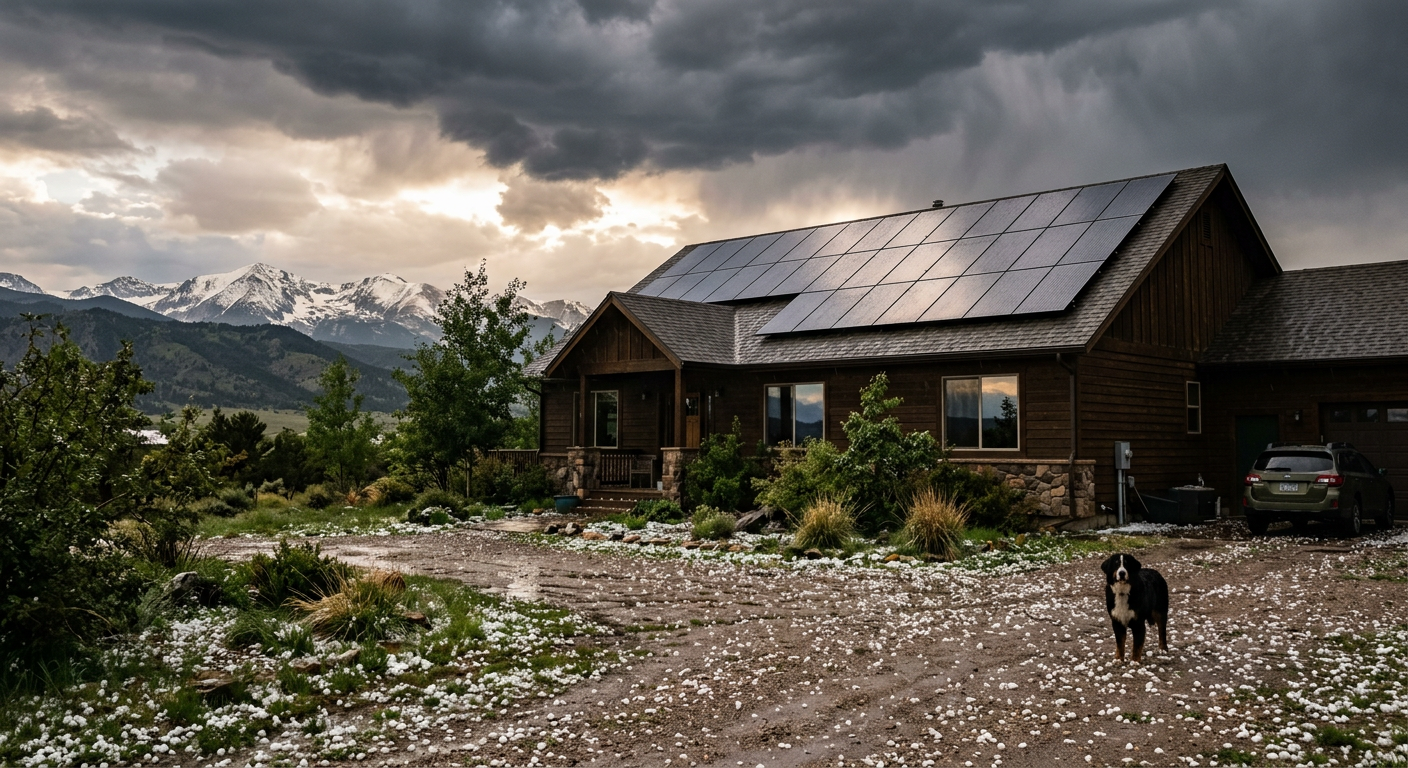
For Colorado homeowners, hail is a fact of life. The Front Range from Fort Collins to Colorado Springs sits in one of the most active hail corridors in the world. Colorado consistently ranks in the top three states for hail damage claims, with annual insured hail losses exceeding $2 billion statewide. Golf-ball-sized hail is routine; baseball-sized hail occurs in the worst storms.
Naturally, homeowners considering solar panels want to know: will my panels survive Colorado's hail? The short answer is that properly selected and installed solar panels have an excellent track record against Colorado hail. This guide explains why, covering testing standards, panel construction, real-world performance, insurance coverage, and what to look for when choosing hail-resistant panels.
How Solar Panels Are Built to Handle Impact
Tempered Glass Front Sheet
The front surface of a modern solar panel is a sheet of tempered glass, typically 3.2 millimeters (about 1/8 inch) thick. Tempered glass is manufactured through a controlled heating and rapid cooling process that creates internal compression stresses, making it approximately four to five times stronger than standard glass of the same thickness.
When tempered glass does break, it shatters into small, relatively harmless granules rather than sharp shards — the same technology used in car side windows. However, the engineering goal is to prevent breakage entirely, not just manage it.
Panel Frame
The aluminum frame surrounding the panel provides structural rigidity and protects the glass edges — the most vulnerable part of any glass panel. A well-designed frame absorbs and distributes impact energy, preventing edge breakage that could propagate across the panel.
Cell Protection
Behind the glass, the solar cells are embedded in EVA (ethylene vinyl acetate) encapsulant — a transparent, rubbery material that cushions the cells against mechanical stress. Even if the glass cracks, the encapsulant often prevents damage to the underlying cells, allowing the panel to continue producing electricity (though at reduced efficiency and with compromised weatherproofing).
Testing Standards: IEC 61215
The Baseline Test
All solar panels sold commercially must pass the IEC 61215 hail test as part of their type certification. The test protocol specifies:
- Ice ball size: 25 millimeters diameter (approximately 1 inch)
- Impact velocity: 23 meters per second (approximately 52 mph)
- Number of impacts: 11 impacts at specified locations on the panel surface
- Target areas: Center, edges, and corners of the panel
- Pass criteria: No visible cracking, no electrical performance loss beyond specifications
This 25mm/23 m/s test represents a moderate hailstone — roughly the size and velocity of small hailstones in a typical Colorado storm. For perspective, a 1-inch hailstone falling at terminal velocity hits the ground at about 35-40 mph. At 52 mph impact velocity, the IEC test simulates a hailstone falling through strong downdraft winds that accelerate it beyond terminal velocity.
Beyond the Standard
Many premium panel manufacturers test beyond IEC 61215, sometimes significantly:
- 35mm (1.4 inch) ice balls at 27 m/s (60 mph) — some manufacturers
- 45mm (1.75 inch) ice balls at 30 m/s (67 mph) — the most robust panels
- Multiple impact testing at the same location to simulate repeated hits
These enhanced tests better represent severe Colorado hailstorms where hailstones regularly exceed 1 inch.
UL 61730 and UL 703
In addition to IEC 61215, panels sold in the United States must meet UL safety standards. UL 61730 (which is replacing UL 703) includes mechanical load and impact testing that complements the IEC hail test. These standards ensure structural integrity under combined stresses — wind, snow load, and impact.
Real-World Performance: Colorado Hailstorms
Our Track Record
ProGreen Solar has been installing panels along the Colorado Front Range through numerous severe hail seasons. Here is what our data shows:
- Hail damage rate: Less than 0.5 percent of panels across our total installed base have sustained hail damage requiring replacement
- Most damage events: Involved hailstones exceeding 2 inches in diameter — well beyond IEC test parameters
- Zero structural failures: No panels have separated from their mounting hardware due to hail impact
- Continued operation after cracks: Panels with minor glass cracks from extreme hail events typically continue producing at 85 to 95 percent of rated output
The 2023 Front Range Hailstorms
The 2023 hail season was particularly severe along the Front Range, with multiple storms producing 2 to 3 inch hail across the Denver metro and Colorado Springs areas. Thousands of roofs and tens of thousands of vehicles were damaged.
Among our installed systems in affected areas:
- The vast majority of panels survived without any visible damage
- A small percentage of panels in the most severely impacted areas sustained glass cracks
- Affected panels were covered by homeowner's insurance and replaced promptly
- No customers experienced full system failure — even cracked panels continued producing
This real-world data is the most compelling evidence that modern solar panels handle Colorado hail well.
Choosing Hail-Resistant Panels
What to Look For
When selecting panels for a Colorado installation, consider these hail-resistance factors:
Glass thickness: Some manufacturers offer 3.2mm glass as standard; a few premium panels use thicker glass (up to 4mm) for enhanced impact resistance. Thicker glass adds weight but improves hail tolerance.
Glass treatment: Some manufacturers apply additional tempering or use specialized glass formulations (like textured glass) that distribute impact energy more effectively.
Enhanced hail testing: Look for panels that have been tested beyond IEC 61215 minimums. Manufacturers that publish their extended hail test results demonstrate confidence in their product's durability.
Manufacturer warranty: The best panels have 25-year product warranties that explicitly cover hail damage under their manufacturing defect provisions. If hail causes a panel to fail, the manufacturer replaces it.
Recommended Panels for Colorado
Based on our installation experience and manufacturer testing data, these panel brands have demonstrated strong hail performance in Colorado:
- REC Alpha Series: Excellent build quality, reinforced frame design. See our REC panel review.
- QCell Q.PEAK DUO: Strong tempered glass, proven track record in Colorado. See our QCell comparison.
- Canadian Solar HiKu/HiHero: Good impact resistance at a competitive price
- Panasonic EverVolt: Premium build quality with strong glass
For our complete panel rankings, see Best Solar Panels in 2026.
Insurance Coverage for Solar Panels
Homeowner's Insurance
Standard homeowner's insurance policies typically cover solar panels as part of your home's structure (for roof-mounted systems) or as "other structures" (for ground-mounted systems). Hail damage to solar panels is treated like hail damage to your roof — it is a covered peril under most policies.
Key insurance considerations:
Verify coverage before installation. Contact your insurance agent to confirm:
- That your solar panels are covered under your existing policy
- The coverage limits are sufficient to replace the panels (typically replacement cost)
- Your deductible applies per occurrence, not per panel
- There are no exclusions for solar equipment
Coverage amount. Your policy should cover the full replacement cost of your solar system. Most policies automatically cover permanently attached solar equipment as part of the dwelling coverage. If your system is particularly expensive or includes battery storage, verify that your coverage limits are adequate.
Premium impact. Adding solar panels may slightly increase your homeowner's insurance premium (reflecting the increased property value and replacement cost). The increase is typically modest — $50 to $200 per year.
Deductible. Your standard deductible applies to hail damage claims. In Colorado, many policies have specific wind/hail deductibles that may be higher than the standard deductible — often 1 to 2 percent of the dwelling coverage amount. Verify your hail deductible before installation.
Filing a Hail Damage Claim
If your panels sustain hail damage:
- Document the damage with photos and video
- Contact your insurance company to file a claim
- Contact ProGreen Solar (or your installer) for a damage assessment
- Get a repair/replacement estimate from your installer
- Schedule replacement once the claim is approved
ProGreen Solar assists our customers with hail damage claims, providing documentation, damage assessments, and replacement services.
Manufacturer Warranty vs. Insurance
If a panel fails due to hail damage, there are two potential coverage paths:
- Manufacturer warranty: Covers manufacturing defects. If the glass broke at hail impact levels below the tested standard, the manufacturer should replace the panel under warranty. However, hail larger than the tested standard is generally not a manufacturing defect.
- Homeowner's insurance: Covers damage from storms and other covered perils, regardless of panel specifications. This is the primary coverage path for hail damage in Colorado.
In practice, insurance is the most common path for Colorado hail claims. The panel manufacturer replaces panels under warranty if the damage represents a product failure; insurance covers event-related damage.
ProGreen Solar's Hail Protection Approach
Our approach to hail protection for Colorado installations:
Equipment Selection
We recommend panels with proven hail performance and test ratings that exceed IEC 61215 minimums. We do not install panels from manufacturers without strong durability track records, even if they offer lower prices.
Installation Quality
Proper installation reduces hail vulnerability:
- Secure mounting prevents panels from flexing or vibrating on impact
- Appropriate torque on mounting hardware ensures panels are firmly held without stress points
- Code-compliant setbacks ensure proper panel spacing and support
Workmanship Warranty
ProGreen Solar's 25-year workmanship warranty covers our installation work. If a mounting system fails or installation-related issues contribute to hail damage, our warranty covers the repair.
Post-Storm Support
After severe hailstorms, we proactively check monitoring data for our installed systems to identify potential damage. We contact affected customers and offer inspection services. If replacement is needed, we handle the manufacturer warranty process and assist with insurance claims.
Should Hail Prevent You from Going Solar?
Absolutely not. The data is clear: modern solar panels handle Colorado's hail climate extremely well. With proper panel selection, quality installation, and adequate insurance coverage, hail risk is manageable and should not deter you from the significant financial and environmental benefits of solar energy.
Consider this perspective: Colorado homeowners do not avoid building homes because of hail. They build quality structures, carry insurance, and accept that occasional repairs may be needed. Solar panels are no different — and they are arguably more hail-resistant than the roofing materials they sit above.
For a complete overview of going solar in Colorado, see our Colorado solar guide.
Get Hail-Ready Solar for Your Home
ProGreen Solar designs every Colorado installation with hail resilience in mind. We select durable panels, install with quality craftsmanship, and support our customers through any weather events.
Use our solar calculator to estimate your system size and savings, or call (303) 484-1410 to speak with our team about a hail-resilient solar installation for your Colorado home.