Solar cell technology has evolved rapidly over the past decade. While most residential panels still use PERC (Passivated Emitter and Rear Contact) cells, a newer technology called heterojunction — abbreviated as HJT — is gaining market share and attention. HJT cells hold the current world record for silicon solar cell efficiency, and panels using this technology consistently rank among the best performers in independent testing.
But what exactly makes heterojunction cells different, and should you care when choosing solar panels for your home? This guide explains the technology in accessible terms, compares it to alternatives, and helps you decide if HJT panels are worth the investment.
The Basics: How Solar Cells Convert Sunlight
Before diving into heterojunction technology specifically, it helps to understand how any silicon solar cell works.
A solar cell is essentially a sandwich of two types of silicon. The top layer is "doped" with phosphorus to create an excess of electrons (n-type silicon). The bottom layer is doped with boron to create electron "holes" (p-type silicon). The boundary between these layers — called the p-n junction — creates an electric field.
When photons from sunlight hit the cell, they knock electrons free from silicon atoms. The electric field at the junction pushes these freed electrons in one direction, creating current flow. Metal contacts on the top and bottom of the cell collect this current and send it to your inverter.
The efficiency of this process depends on how well the cell captures photons, generates electron-hole pairs, and moves those charges to the contacts without losing them to recombination (where electrons fall back into holes before being collected).
For a broader overview, see our guide on how solar panels work.
What Makes Heterojunction Cells Different
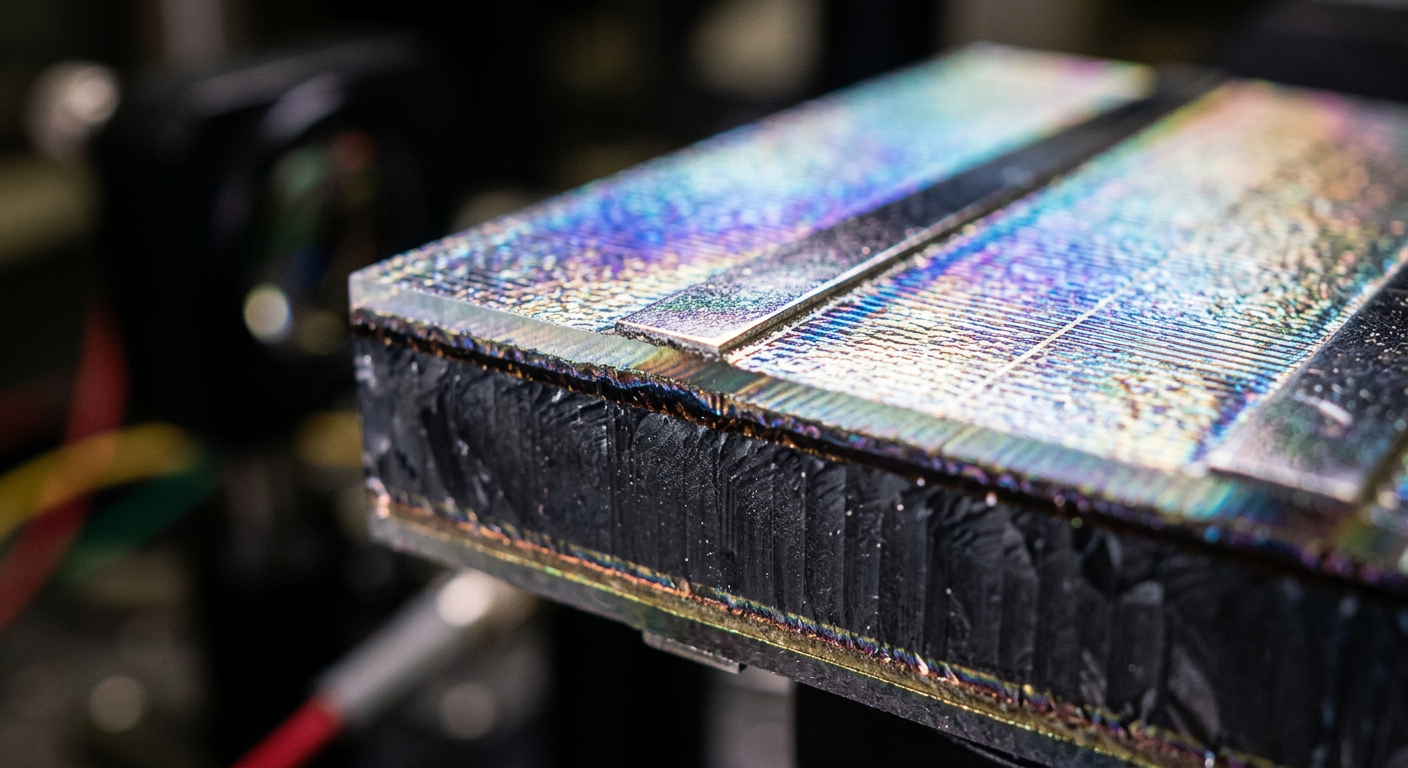
The "hetero" in heterojunction means "different." A heterojunction cell combines two different types of semiconductor material: crystalline silicon and amorphous (thin-film) silicon.
The HJT Cell Structure
An HJT cell has a layered structure, from top to bottom:
- Anti-reflective coating — minimizes light reflection so more photons enter the cell
- Transparent conductive oxide (TCO) — conducts electricity while allowing light to pass through
- Thin amorphous silicon layer (intrinsic + n-type) — approximately 5 to 10 nanometers thick
- Crystalline silicon wafer (n-type) — the main power-generating layer, about 120 to 180 micrometers thick
- Thin amorphous silicon layer (intrinsic + p-type) — another ultra-thin layer on the back
- Transparent conductive oxide (TCO)
- Metal contact grid
The key innovation is those ultra-thin amorphous silicon layers on both sides of the crystalline wafer. These layers "passivate" the surfaces of the crystalline silicon, meaning they fill in dangling atomic bonds that would otherwise trap and recombine charge carriers.
Why Passivation Matters So Much
In any solar cell, the surfaces of the silicon wafer are where the crystal structure abruptly ends. These surfaces are full of defects — broken bonds, impurities, and irregularities — that act as recombination centers. When an electron generated deep in the cell migrates toward the surface, it can get trapped at these defects and lose its energy as heat instead of contributing to electrical current.
The amorphous silicon layers in an HJT cell provide the best surface passivation achievable in mass production today. This dramatically reduces surface recombination, allowing more of the generated charge carriers to reach the contacts and contribute to power output.
The result: higher voltage, higher efficiency, and lower energy losses as heat.
Key Advantages of HJT Technology
Higher Efficiency
HJT cells consistently achieve the highest efficiencies among mass-produced silicon solar cells. The current world record for a silicon solar cell is 26.81 percent efficiency, achieved by LONGi using a heterojunction-based design. Commercial HJT panels from manufacturers like REC, Meyer Burger, and Huasun achieve module-level efficiencies of 21.5 to 23 percent.
For comparison, standard PERC panels typically achieve 20 to 21.5 percent efficiency, and TOPCon panels reach 21 to 22.5 percent. The difference may seem small, but on a space-constrained roof, an extra 1 to 2 percent efficiency means measurably more energy production over 25 years. For more on why efficiency matters, read our solar panel efficiency guide.
Superior Temperature Coefficient
This is arguably HJT's most important advantage for real-world performance. All solar cells lose efficiency as they heat up. The rate of this loss is called the temperature coefficient, measured in percent per degree Celsius.
- Standard PERC cells: -0.35 to -0.40%/degree C
- TOPCon cells: -0.30 to -0.35%/degree C
- HJT cells: -0.24 to -0.26%/degree C
On a hot summer day in Colorado, panel surface temperatures can reach 65 to 75 degrees Celsius (150 to 167 degrees Fahrenheit) — about 40 to 50 degrees above the standard test condition of 25 degrees C. At those temperatures:
- A PERC panel loses 14 to 20 percent of its rated output
- A TOPCon panel loses 12 to 17.5 percent
- An HJT panel loses only 9.6 to 13 percent
This means HJT panels produce more energy during the hottest, sunniest hours — exactly when electricity is most valuable if you are on time-of-use rates. Over a full year in Colorado, the temperature advantage alone can translate to 3 to 5 percent more energy production compared to PERC panels of the same wattage rating.
Lower Degradation Rate
Solar panels gradually lose output over time as their cells degrade from UV exposure, thermal cycling, and other stresses. The rate of this degradation directly affects how much energy your panels produce over their lifetime.
HJT panels benefit from lower degradation rates:
- Standard PERC panels: 0.40 to 0.55% per year
- TOPCon panels: 0.35 to 0.45% per year
- HJT panels: 0.25 to 0.35% per year
After 25 years, an HJT panel retains approximately 91 to 94 percent of its original output, while a PERC panel retains about 86 to 90 percent. The cumulative energy production difference over the system's lifetime can be 5 to 8 percent — a meaningful gain that compounds year after year.
Several factors contribute to this lower degradation:
- No light-induced degradation (LID): HJT cells use n-type silicon wafers, which are immune to the boron-oxygen LID that affects p-type PERC cells.
- No light and elevated temperature induced degradation (LeTID): This newly identified degradation mechanism affects PERC and some TOPCon cells but not HJT.
- Better surface passivation stability: The amorphous silicon passivation layers are inherently stable over time.
Bifacial Performance
HJT cells are naturally bifacial — they generate electricity from both sides. The symmetric structure (amorphous silicon layers on both the front and back) means the rear side achieves nearly the same efficiency as the front.
In practice, bifacial gain depends on the mounting surface and its reflectivity. Ground-mount systems over light-colored surfaces can see 10 to 30 percent additional production from the rear side. Rooftop installations see more modest bifacial gains (2 to 5 percent) from light reflected off the roof surface and surroundings.
Low-Light Performance
The excellent passivation in HJT cells means they perform well in low-light conditions — early morning, late afternoon, and cloudy days. When light intensity drops, poorly passivated cells lose a disproportionate amount of their output because recombination losses become a larger fraction of total generation. HJT's superior passivation maintains a higher percentage of rated output in diffuse and low-angle light.
HJT Panel Manufacturers
REC Group
REC's Alpha Series was one of the first mass-produced HJT panels available in the residential market. Their current Alpha Pure-R panels achieve up to 22.6 percent efficiency with a temperature coefficient of -0.24%/degree C. REC offers a 25-year product and performance warranty with guaranteed 92 percent output at year 25. For a comparison of REC panels with alternatives, see our QCell vs. REC comparison.
Meyer Burger
This Swiss company operates HJT cell and module production in Germany. Their panels emphasize European manufacturing quality and sustainability. Meyer Burger panels achieve up to 22.1 percent efficiency with a strong temperature coefficient and a 25-year warranty guaranteeing 92 percent output.
LONGi
While LONGi is best known for their PERC and TOPCon panels, they hold the world record for HJT cell efficiency and have begun mass production of HJT modules. Their scale could drive costs down significantly.
Huasun
A Chinese manufacturer focused exclusively on HJT technology, Huasun has rapidly scaled production and offers competitive pricing. Their panels achieve up to 23 percent module efficiency.
HJT vs. PERC vs. TOPCon: Which Technology to Choose
PERC (Passivated Emitter and Rear Contact)
PERC remains the dominant technology with about 75 percent market share. It is mature, well-understood, and the most affordable option. PERC panels are an excellent choice for budget-conscious installations where roof space is not severely constrained.
However, PERC technology is approaching its practical efficiency ceiling. Most experts expect PERC to be gradually replaced by TOPCon and HJT over the next three to five years.
TOPCon (Tunnel Oxide Passivated Contact)
TOPCon is the fastest-growing technology, rapidly closing the gap with HJT in efficiency while maintaining cost closer to PERC. TOPCon cells use a different passivation approach — a thin tunnel oxide layer with a polysilicon contact — that achieves excellent but not quite HJT-level passivation.
TOPCon's advantage is that it can be manufactured on modified PERC production lines, keeping production costs lower. Many Chinese manufacturers have converted PERC lines to TOPCon, leading to rapid market share growth.
When HJT Wins
HJT is the premium choice — higher efficiency, better temperature performance, lower degradation — but at a higher price. Choose HJT panels when:
- Roof space is limited and you need maximum watts per square foot
- You live in a hot climate or at altitude (like Colorado) where the temperature coefficient advantage is amplified
- You want maximum lifetime production and are willing to pay more upfront for lower degradation
- Long-term value matters more than upfront cost — HJT panels produce more energy over 25 to 30 years
For our recommendations on the best panels available today, see our best solar panels in 2026 guide.
The Colorado Advantage for HJT
Colorado's climate and geography are particularly well-suited to HJT technology for two reasons:
Altitude intensifies UV exposure. At Denver's elevation of 5,280 feet, UV radiation is about 25 percent stronger than at sea level. Higher altitude means thinner atmosphere, which allows more solar radiation to reach the panels. HJT's superior efficiency converts more of this radiation to electricity.
Temperature swings are extreme. Colorado regularly sees 30 to 40 degree temperature swings in a single day, and summer panel temperatures easily exceed 70 degrees C. HJT's low temperature coefficient means less production loss during hot afternoons. Learn more about how Colorado's climate affects solar performance.
Snow reflection boosts bifacial gain. Colorado homes near the mountains or at higher elevations have snow on the ground for significant portions of the year. Snow is highly reflective, enhancing bifacial production by 5 to 15 percent during snow-covered months.
Cost Considerations
HJT panels currently carry a premium of $0.05 to $0.15 per watt over comparable PERC panels, and $0.02 to $0.08 per watt over TOPCon. For a typical 10 kW system, this translates to an additional $500 to $1,500.
However, HJT's higher lifetime energy production often more than compensates for this premium. When you calculate the levelized cost of energy (LCOE) — the total cost divided by total lifetime energy production — HJT panels frequently achieve the lowest LCOE despite the higher upfront cost.
The federal tax credit applies equally to all panel types, so the 30 percent credit reduces the absolute dollar premium proportionally.
The Future of HJT
HJT is positioned to become the dominant solar cell technology within the next decade. Its advantages in efficiency, degradation, and temperature performance are fundamental to its design rather than incremental improvements. As production scales and costs decrease, the price premium over PERC and TOPCon will continue to shrink.
The next frontier is tandem cells — stacking a perovskite solar cell on top of an HJT silicon cell. LONGi has already demonstrated a perovskite-HJT tandem cell at 33.9 percent efficiency, far exceeding the theoretical limit of single-junction silicon. These tandem cells could reach commercial production within two to four years.
Should You Choose HJT Panels?
If your budget allows and your installer offers HJT options, they are an excellent choice — particularly in Colorado's high-altitude, temperature-variable climate. The higher upfront cost is offset by greater lifetime production, lower degradation, and better hot-weather performance.
At ProGreen Solar, we install HJT panels from REC and other leading manufacturers alongside high-quality PERC and TOPCon options. We will help you evaluate whether the HJT premium makes financial sense for your specific installation.
Use our solar calculator to estimate your system size and savings, or call (303) 484-1410 to discuss which panel technology is the best fit for your roof, budget, and energy goals.