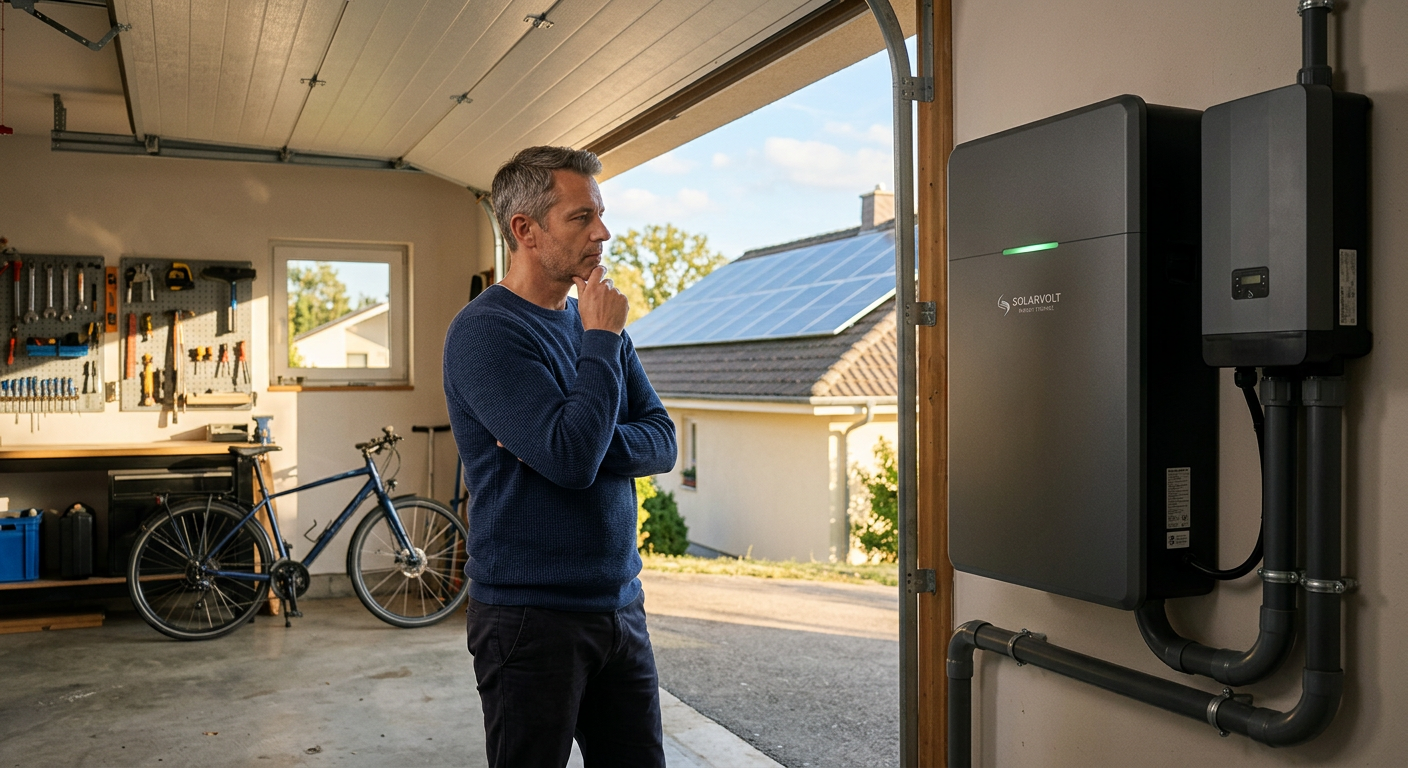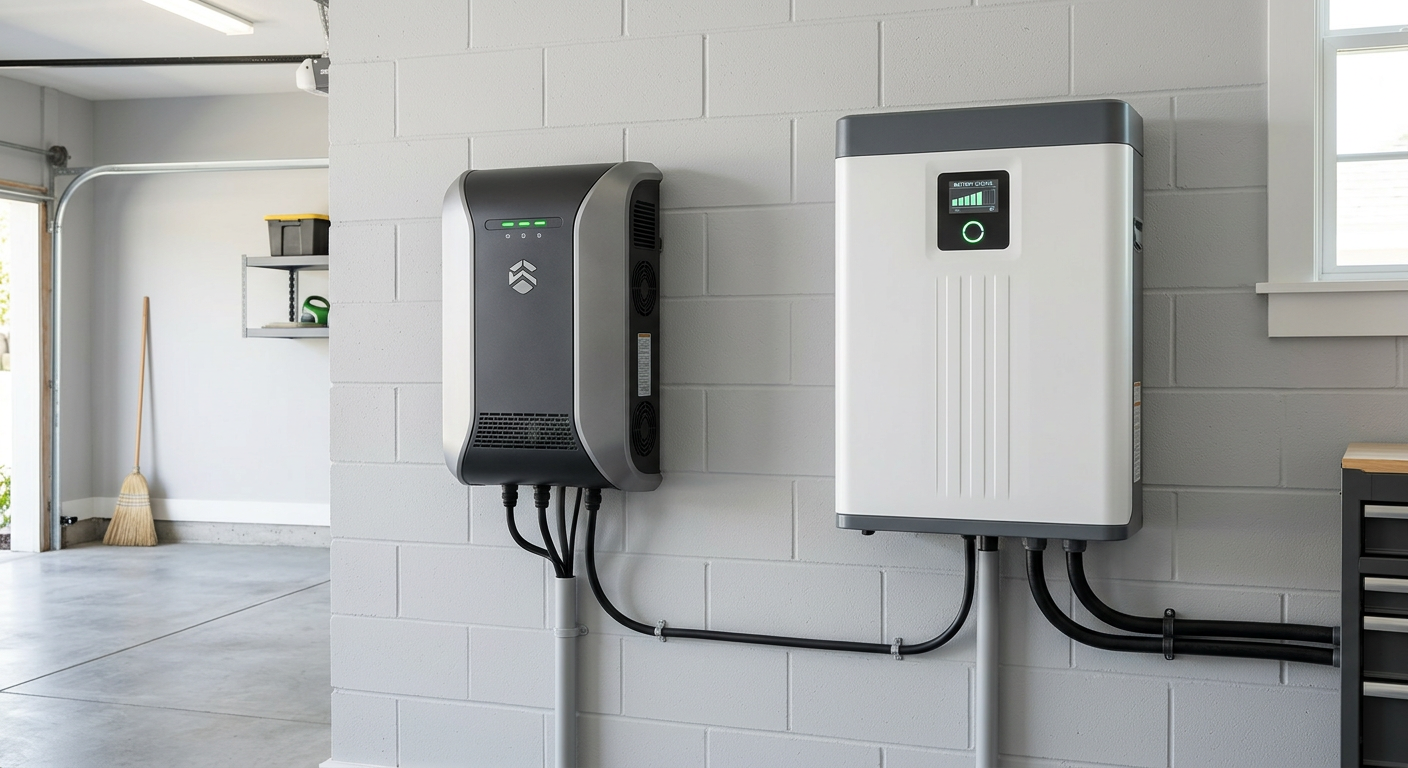
Solar batteries have become a common addition to residential solar systems, but most homeowners never learn what actually happens inside these sleek boxes mounted on their garage walls. Understanding the basics of battery technology helps you make smarter purchasing decisions, set realistic expectations, and take better care of your investment.
This guide explains how home solar batteries work in accessible terms — no chemistry degree required.
The Basic Concept
A solar battery stores electrical energy in chemical form and releases it as electrical energy when needed. It is the same fundamental principle as the battery in your phone or laptop, scaled up dramatically.
During the day, your solar panels produce electricity. When they produce more than your home is using, the excess energy charges the battery. When the sun goes down or your panels cannot keep up with demand, the battery discharges to power your home. If the grid goes down, the battery can power essential (or all) circuits in your home.
Think of it as a water tank. Solar panels are the faucet filling the tank during the day. Your home's electrical consumption is a drain at the bottom. The battery stores water when inflow exceeds outflow and provides water when outflow exceeds inflow.
Lithium-Ion Chemistry: What Is Inside
Nearly all modern home solar batteries use lithium-ion chemistry. Two specific types dominate the residential market:
NMC (Nickel Manganese Cobalt Oxide)
Used in the Tesla Powerwall, SolarEdge, and Generac batteries.
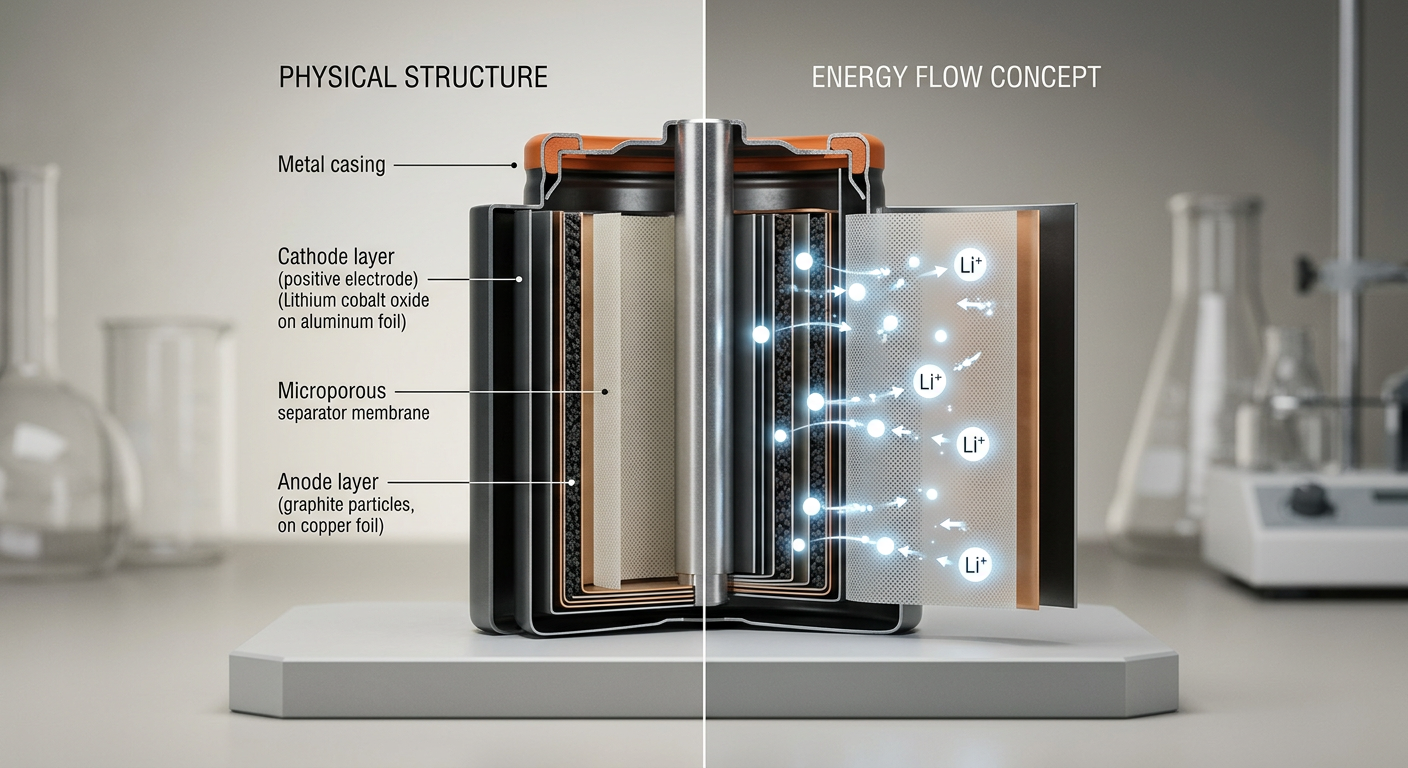
The battery's cathode (positive terminal) contains a layered oxide of nickel, manganese, and cobalt. The anode (negative terminal) is made of graphite. Lithium ions shuttle between the cathode and anode through a liquid electrolyte.
During charging: Lithium ions move from the cathode through the electrolyte to the anode, where they insert themselves between layers of graphite atoms. This process stores energy in the chemical bonds.
During discharging: The process reverses. Lithium ions move from the anode back to the cathode, releasing energy as electrical current that flows through an external circuit to power your home.
NMC batteries offer:
- High energy density (more storage per unit of weight and volume)
- Good power output characteristics
- Established manufacturing at scale
- Typical cycle life of 3,000 to 5,000 full cycles
LFP (Lithium Iron Phosphate)
Used in Enphase IQ Battery and Franklin batteries.
LFP batteries use an iron phosphate cathode instead of the nickel-manganese-cobalt oxide used in NMC. The operating principle is the same — lithium ions shuttle between cathode and anode — but the different cathode chemistry creates distinct performance characteristics.
LFP batteries offer:
- Superior thermal stability (inherently safer, lower fire risk)
- Longer cycle life (5,000 to 10,000+ full cycles)
- No cobalt (more environmentally sustainable, lower raw material cost)
- Lower energy density (larger and heavier per kWh of storage)
- Slightly lower round-trip efficiency
Which Chemistry Is Better?
Neither is objectively superior — they represent different trade-offs. NMC offers more compact, lighter batteries with higher round-trip efficiency. LFP offers longer lifespan, better safety, and lower long-term cost per cycle.
For home storage, both chemistries are safe, well-proven, and suitable. Your choice is typically driven by which battery brand and features you prefer rather than chemistry specifically. For detailed product comparisons, see our home battery storage guide.
Charge and Discharge Cycles
What Is a Cycle?
One full cycle is a complete discharge from 100 percent to 0 percent followed by a complete recharge to 100 percent. In practice, batteries rarely cycle from completely full to completely empty. Partial cycles count as partial cycles — discharging from 100 percent to 50 percent and recharging counts as half a cycle.
Cycle Life
Every battery has a limited number of cycles before its capacity degrades significantly. Modern home batteries are rated for:
- NMC batteries: 3,000 to 5,000 cycles (at 80% capacity retention)
- LFP batteries: 5,000 to 10,000+ cycles (at 80% capacity retention)
For a battery cycling once per day, 5,000 cycles represents approximately 13.7 years of daily use. At 10,000 cycles, that extends to over 27 years. This is why LFP batteries often carry longer warranties — their chemistry supports more cycles before degradation.
Degradation Over Time
Like all batteries, home solar batteries gradually lose capacity over their lifetime. This degradation is caused by:
- Solid electrolyte interphase (SEI) growth: A thin film builds up on the anode surface over time, consuming lithium ions and reducing available capacity
- Cathode structural changes: Repeated ion insertion and extraction gradually alters the cathode crystal structure
- Electrolyte decomposition: Chemical side reactions slowly consume the electrolyte
The rate of degradation depends on:
- Temperature: Higher operating temperatures accelerate degradation. This is why batteries have thermal management systems (heating and cooling). For Colorado's climate considerations, see our Colorado performance guide.
- Depth of discharge: Deeper discharges stress the battery more than shallow ones
- Charge/discharge rate: Faster charging and discharging generates more heat and stress
- State of charge: Storing a battery at very high or very low charge for extended periods accelerates degradation
Most home battery warranties guarantee at least 70 to 80 percent of original capacity at end of warranty (10 to 15 years).
Depth of Discharge (DoD)
Depth of discharge is the percentage of the battery's total capacity that is actually used. Early lithium-ion batteries could only safely discharge to 80 or 90 percent of their total capacity — the remaining 10 to 20 percent was reserved to protect the cells from damage.
Modern home batteries have improved significantly:
- Tesla Powerwall 3: 100% DoD (13.5 kWh usable out of 13.5 kWh total)
- Enphase IQ Battery 5P: 100% DoD (5.0 kWh usable out of 5.0 kWh total)
- Most current batteries: 95-100% DoD
When comparing batteries, always look at usable capacity (after DoD), not total capacity. A 15 kWh battery with 90% DoD provides only 13.5 kWh of usable storage — the same as a 13.5 kWh battery with 100% DoD.
Round-Trip Efficiency
Round-trip efficiency is the percentage of energy that you get back out of the battery compared to what you put in. Energy is lost as heat during both charging and discharging.
- Tesla Powerwall 3: 97.5% round-trip efficiency (DC to battery to DC)
- Enphase IQ Battery 5P: 96% round-trip efficiency
- Typical range: 89-97.5% depending on the battery
At 96 percent efficiency, for every 10 kWh of solar energy you store in the battery, you get 9.6 kWh back. The missing 0.4 kWh is lost as heat.
Over a year of daily cycling, this efficiency loss adds up. For a 13.5 kWh battery cycling daily at 95 percent efficiency:
- Annual energy stored: 13.5 kWh x 365 = 4,927.5 kWh
- Annual energy lost: 4,927.5 x 0.05 = 246 kWh
- Cost of lost energy (at $0.15/kWh): $37/year
The efficiency loss is relatively small in dollar terms, but it is a real factor to consider when comparing batteries.
DC Coupling vs. AC Coupling
This is one of the most important technical decisions in a solar-plus-storage system. It determines how the battery connects to your solar panels and home.
DC-Coupled Batteries
In a DC-coupled system, the battery connects to the solar panels on the DC (direct current) side, before the inverter. Solar energy charges the battery directly as DC, without first being converted to AC.
How it works:
- Solar panels produce DC electricity
- A charge controller directs DC electricity to the battery or the inverter
- The battery stores DC electricity directly
- When the battery discharges, DC electricity flows to the inverter for AC conversion
- The inverter converts DC to AC for your home
Advantages:
- Higher charging efficiency (no DC-to-AC-to-DC conversion losses)
- Better performance when solar production closely matches battery charging
- The Tesla Powerwall 3 with its integrated inverter is essentially DC-coupled
Disadvantages:
- Less flexible — the battery, solar panels, and inverter must be compatible
- Adding a battery to an existing solar system may require replacing the inverter
- Limited to the inverter's maximum DC input
AC-Coupled Batteries
In an AC-coupled system, the battery has its own inverter/charger and connects on the AC (alternating current) side of the system.
How it works:
- Solar panels produce DC electricity
- Solar inverter converts DC to AC
- AC electricity powers your home
- Excess AC electricity flows to the battery inverter, which converts it back to DC for storage
- When the battery discharges, its inverter converts DC back to AC for your home
Advantages:
- Works with any solar inverter — can be added to any existing solar system
- More flexible for system design and future expansion
- Enphase IQ Battery uses AC coupling for seamless integration with Enphase microinverters
Disadvantages:
- Slightly lower round-trip efficiency due to double conversion (DC-to-AC-to-DC-to-AC)
- Additional inverter component (though integrated in most AC-coupled batteries)
Which Is Better?
For new installations where the battery is part of the original design, DC coupling offers a slight efficiency advantage. For adding a battery to an existing solar system, AC coupling is usually the practical choice because it does not require replacing your existing inverter.
In practice, the efficiency difference between AC and DC coupling is small (1 to 3 percent) and is usually outweighed by compatibility and flexibility considerations. For more on inverter technology, see our microinverters vs. string inverters guide.
Battery Management System (BMS)
Every home battery includes a sophisticated Battery Management System — the electronic brain that keeps the battery operating safely and efficiently.
What the BMS Does
Cell balancing: A home battery contains hundreds or thousands of individual lithium-ion cells wired together. The BMS ensures each cell charges and discharges evenly, preventing any single cell from being overcharged or over-discharged.
Temperature management: The BMS monitors cell temperatures and controls the thermal management system (fans, liquid cooling, or heating elements) to keep cells within their optimal temperature range. For Colorado's temperature extremes, this is critical — the BMS activates heating during cold winter nights and cooling during hot summer days.
Voltage and current protection: The BMS prevents overcharging (which can cause thermal runaway and fire) and over-discharging (which can permanently damage cells). It enforces safe charging and discharging rates.
State of charge estimation: The BMS calculates and reports how much energy is available in the battery at any time, compensating for cell aging and temperature effects.
Fault detection: The BMS monitors for cell failures, connection issues, insulation faults, and other problems. It can shut down the battery to prevent damage or safety hazards.
Thermal Management
Temperature control is crucial for battery performance and longevity. Home batteries use one of three thermal management approaches:
Passive Cooling
The simplest approach — natural air convection cools the battery. This is adequate for mild climates but may be insufficient for Colorado's hot summers and cold winters.
Active Air Cooling
Fans circulate air through the battery enclosure. More effective than passive cooling and used in some residential batteries. However, fans can introduce dust and require maintenance.
Liquid Cooling
The most effective approach — a liquid coolant circulates through channels in the battery pack, absorbing heat and rejecting it through a heat exchanger. The Tesla Powerwall uses liquid cooling, which allows it to operate efficiently across its full -4 to 122 degree F temperature range.
For Colorado installations, batteries with active thermal management (liquid or active air cooling) are strongly preferred. Our climate's temperature extremes — from below-zero winter nights to 100+ degree summer days — demand robust thermal management to maintain performance and longevity.
How the Battery Fits Into Your Solar System
A complete solar-plus-storage system includes:
- Solar panels on your roof generating DC electricity
- Inverter(s) converting DC to AC (microinverters or string inverter)
- Battery storing excess energy
- Transfer switch / gateway managing the transition between grid-connected and backup modes
- Electrical panel distributing power to your home's circuits
- Monitoring system tracking production, consumption, and battery status
During normal operation, the system prioritizes: first, powering your home from solar; second, charging the battery with excess solar; third, exporting remaining excess to the grid. When solar production falls below consumption, the system draws from the battery first, then from the grid.
During an outage, the transfer switch disconnects from the grid, and the battery powers your selected circuits. If solar panels are producing, they continue to charge the battery while simultaneously powering the home, potentially providing indefinite backup during daylight hours.
Taking Care of Your Battery
Modern home batteries require minimal maintenance, but a few practices extend their lifespan:
- Keep the installation area ventilated — adequate air flow helps the thermal management system work efficiently
- Avoid extremes — if possible, install the battery in a location with moderate temperatures (garage or indoor utility room)
- Monitor regularly — check the monitoring app periodically for alerts or unusual behavior
- Keep software updated — battery management firmware updates can improve performance and longevity
Learn More About Battery Options
Now that you understand how solar batteries work, you are better equipped to evaluate specific products. Explore these resources:
- Home Battery Storage Guide — comprehensive comparison of all major batteries
- Tesla Powerwall Review — detailed analysis of the market leader
- Powerwall vs. Enphase IQ Battery — head-to-head comparison
- Do I Need a Solar Battery? — honest cost-benefit analysis
- Whole-Home vs. Partial Backup — sizing your battery system
Ready to explore battery storage for your home? Use our solar calculator to model solar-plus-storage options, or call ProGreen Solar at (303) 484-1410 for expert guidance on the right battery system for your needs and budget.