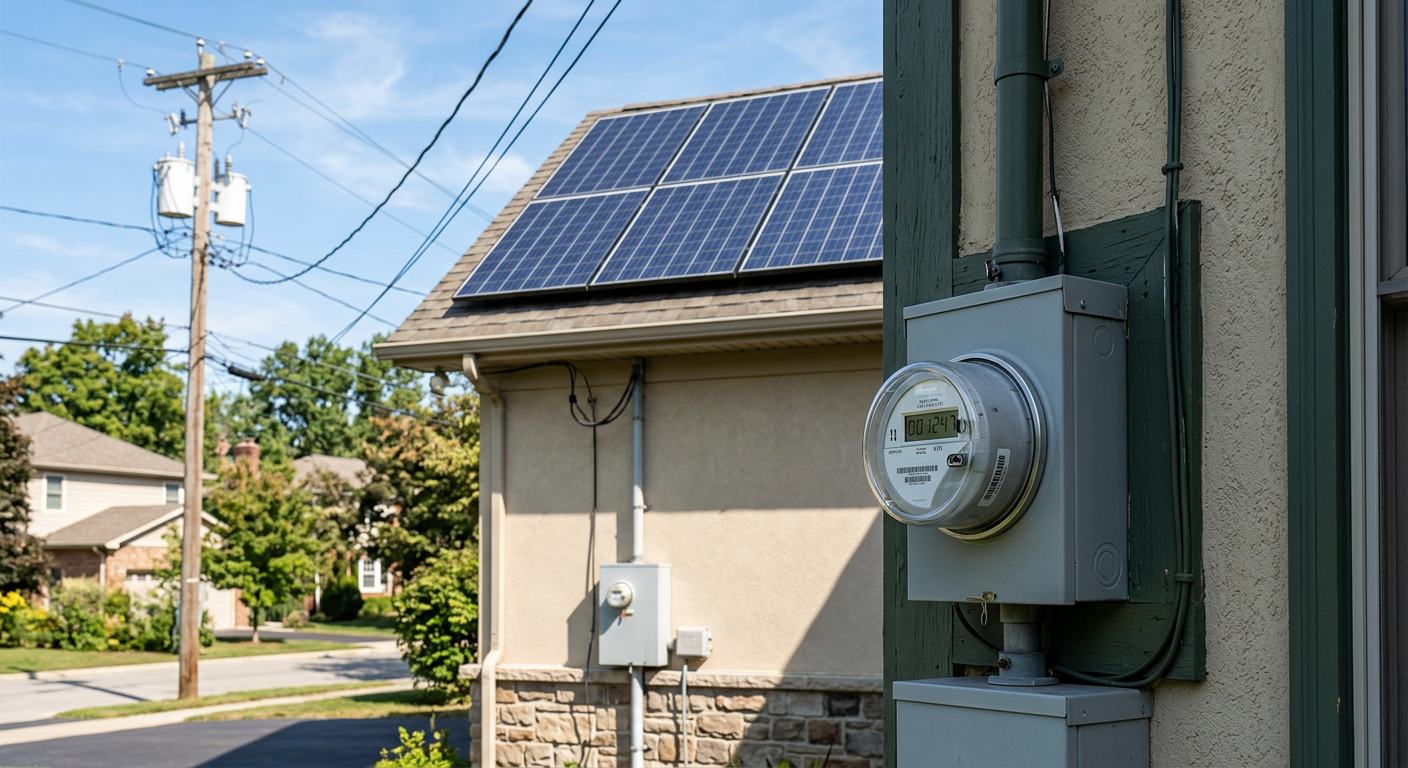
If you are considering solar panels for your home, net metering is arguably the most important concept you need to understand. It is the mechanism that turns your solar panels from a daytime-only power source into a 24/7 money-saving machine. Without net metering, the financial case for residential solar would be far weaker. With it, most Colorado homeowners can reduce their electric bills by 80 to 100 percent.
Let us break down exactly what net metering is, how it works, and what it means for your wallet.
Net Metering in Plain English
Net metering is a billing arrangement with your utility company that allows you to send excess solar electricity to the grid in exchange for credits on your electric bill. Think of the electrical grid as a giant battery: when your panels overproduce during the day, you "deposit" electricity into the grid. When you need electricity at night or on cloudy days, you "withdraw" it. You only pay for the net difference.
Here is a typical daily cycle for a Colorado home with solar:
Morning (6 AM - 9 AM): Your panels begin producing electricity as the sun rises. Production starts low but climbs steadily. Your home is drawing power for morning routines — coffee maker, lights, hot water. At this point, your panels may not be producing enough to cover all your usage, so you draw a small amount from the grid.
Midday (10 AM - 3 PM): Your panels are producing at or near full capacity. In Colorado's abundant sunshine, a 7 kW system can produce 5 to 6 kW of power. Meanwhile, with the family at work and school, your home may only be consuming 1 to 2 kW. The surplus 3 to 5 kW flows to the grid, and your meter tracks these credits.
Afternoon/Evening (4 PM - 10 PM): Production tapers off as the sun sets. Your household consumption spikes — cooking dinner, running the dishwasher, watching TV, charging devices. You begin drawing from the grid again, but the credits you earned during the day offset this consumption.
Night (10 PM - 6 AM): Zero solar production. Your home runs entirely on grid electricity, but the credits from your daytime exports continue to offset the cost.
At the end of the month, your electric bill reflects only the net energy you consumed from the grid minus your exported credits. For a well-designed solar system, this net amount is often very small — sometimes just a basic connection fee of $10 to $15.
How Net Metering Credits Work
The specifics of credit calculation vary by utility, but here is the general framework for Colorado:
One-to-One Credits (Retail Rate)
Under traditional net metering — which Colorado still maintains for most customers — each kilowatt-hour you export to the grid earns a credit at the full retail electricity rate. If your utility charges $0.14 per kWh, you receive a $0.14 credit for every kWh you export. This is the most favorable arrangement for solar homeowners.
Monthly Rollover
Credits earned in one month roll over to the next. This is crucial because solar production varies by season. In Colorado, June typically produces 60 to 70 percent more electricity than December. The credits you accumulate during the high-production summer months help pay for the electricity you consume during the lower-production winter months.
Annual True-Up
At the end of your billing year, any remaining excess credits are typically reconciled. Policies vary by utility:
- Xcel Energy — Excess credits at year-end are paid out at the average hourly incremental cost (a wholesale rate, significantly less than retail). This means you should aim to size your system to match your annual consumption rather than significantly overproducing.
- United Power — Similar structure with monthly rollover and an annual reconciliation.
- Colorado Springs Utilities — Offers net metering with credits rolling month to month.
The "Net" in Net Metering
The word "net" refers to the mathematical netting of your consumption and production. If you consume 900 kWh and produce 1,100 kWh in a month, you exported a net 200 kWh. Those 200 kWh become credits for future months. If instead you consumed 1,200 kWh and produced 900 kWh, you would pay your utility for the net 300 kWh you consumed.
Real-World Savings Example
Let us walk through a year of net metering for a typical Colorado homeowner with a 7 kW solar system:
Annual electricity consumption: 10,800 kWh (900 kWh per month average) Annual solar production: 11,000 kWh Electricity rate: $0.14 per kWh
| Month | Solar Production | Home Consumption | Net (Export/Import) | Credit Balance |
|---|---|---|---|---|
| January | 600 kWh | 1,050 kWh | -450 kWh | Credits used |
| February | 700 kWh | 950 kWh | -250 kWh | Credits used |
| March | 900 kWh | 850 kWh | +50 kWh | 50 kWh |
| April | 1,050 kWh | 800 kWh | +250 kWh | 300 kWh |
| May | 1,200 kWh | 800 kWh | +400 kWh | 700 kWh |
| June | 1,300 kWh | 900 kWh | +400 kWh | 1,100 kWh |
| July | 1,250 kWh | 1,050 kWh | +200 kWh | 1,300 kWh |
| August | 1,150 kWh | 1,000 kWh | +150 kWh | 1,450 kWh |
| September | 1,000 kWh | 850 kWh | +150 kWh | 1,600 kWh |
| October | 800 kWh | 850 kWh | -50 kWh | 1,550 kWh |
| November | 600 kWh | 900 kWh | -300 kWh | 1,250 kWh |
| December | 450 kWh | 800 kWh | -350 kWh | 900 kWh |
Annual result: This homeowner produced 200 kWh more than they consumed. Their monthly electric bill consisted of only the basic grid connection fee ($10-15/month), saving approximately $1,400 per year compared to their pre-solar bills. The 900 kWh in remaining credits at year-end would be reconciled at wholesale rates.
Colorado's Net Metering Landscape
Colorado has been a leader in solar-friendly policies. Here is what you need to know:
State Mandate
Colorado law requires investor-owned utilities and most cooperatives to offer net metering to residential customers with solar systems up to 25 kW (more than enough for any residential system). This mandate provides stability and predictability for homeowners investing in solar.
Xcel Energy (Colorado's Largest Utility)
Xcel serves the Denver metro area, Boulder, and much of the Front Range. Their net metering program offers:
- Monthly rollover of excess credits
- Credits at the full retail rate
- Annual reconciliation of excess credits at wholesale rates
- No caps on individual system size (up to 25 kW for residential)
- Bidirectional meter installed at no charge
Community Solar
If your roof is not suitable for panels, Colorado's robust community solar program lets you subscribe to a share of a larger solar installation elsewhere. You receive credits on your bill just as if the panels were on your roof, typically at 5 to 15 percent below standard rates.
Why Net Metering Matters for Solar Economics
Net metering fundamentally changes the financial equation of solar:
Without net metering: You would only benefit from solar electricity that you consume in real time. During midday, when your panels are producing at peak and your home may be unoccupied, the excess electricity would simply be wasted. You would only save money during the hours when your production and consumption overlap — perhaps 30 to 50 percent of your total production.
With net metering: Every kilowatt-hour your panels produce has full value, whether consumed instantly or exported for future credits. This means 100 percent of your solar production contributes to savings, making solar 2 to 3 times more financially beneficial than it would be otherwise.
This is why net metering is often called the single most important policy for residential solar economics.
Strategies to Maximize Net Metering Benefits
Right-Size Your System
The most effective strategy is sizing your system to match your annual electricity consumption as closely as possible. Overproduction wastes money (excess credits are reconciled at wholesale rates), while underproduction leaves savings on the table. A ProGreen Solar consultant will analyze your past 12 months of electricity bills to determine the ideal system size.
Shift Consumption to Daytime
While net metering means the timing of your consumption does not matter for credits, using more electricity during peak solar production hours maximizes your "self-consumption" — electricity that flows directly from panels to appliances without touching the grid. This avoids any potential losses from the net metering credit/debit process.
Practical tips:
- Run your dishwasher, laundry, and other heavy appliances during the day
- Set your EV to charge during peak solar hours
- Program your water heater (if electric) to heat during midday
- Use smart thermostats to pre-cool your home in the afternoon
Consider Time-of-Use Rates
Some Colorado utilities offer optional time-of-use rates where electricity costs more during peak hours (typically 3-7 PM) and less during off-peak hours. With solar and net metering, you can export electricity during expensive peak hours and import during cheap off-peak hours, effectively arbitraging the rate difference.
Add Battery Storage
As discussed in our Grid-Tied vs. Off-Grid guide, adding a battery lets you store excess solar for evening use instead of exporting it. This is especially valuable if your utility introduces less favorable net metering rates in the future.
The Future of Net Metering
Net metering policies are evolving across the country. California's transition to "net billing" in 2023 significantly reduced the value of exported solar electricity for new customers. Other states are considering similar changes.
What this means for Colorado: While Colorado currently has strong net metering protections, there is no guarantee these policies will remain unchanged forever. Homeowners who install solar now lock in their net metering arrangement under current rules, which are typically grandfathered for 20 years when policies change.
This creates a compelling urgency: the sooner you go solar, the longer you are protected by today's favorable net metering rules. Waiting could mean installing under less favorable terms.
Frequently Asked Questions
Do I still have an electric bill with net metering?
Yes, but it is dramatically reduced. Most utilities charge a small monthly connection fee ($10-15) regardless of your energy consumption. You may also see small charges for grid services or demand charges. But your actual energy charges can drop to zero.
What happens during a power outage?
Standard grid-tied systems shut off during outages for safety reasons, even with net metering credits available. This is why we recommend pairing your system with battery backup if outage protection is important to you.
Can my utility refuse to offer net metering?
In Colorado, utilities are required by law to offer net metering for eligible systems. You have a legal right to connect a solar system and receive credits for your exported electricity.
Does net metering work with battery storage?
Yes. A battery-backed system can be configured to maximize self-consumption (reducing your reliance on net metering) or to optimize exports during peak rate hours (maximizing the value of each exported kWh).
Take the Next Step
Net metering is the financial engine that makes residential solar one of the best investments you can make. Combined with the 30 percent federal tax credit and Colorado incentives, the math overwhelmingly favors going solar now.
Ready to see how net metering will work for your specific home and utility? Get your free solar estimate from ProGreen Solar, or call us at (303) 484-1410. We will model your production, consumption, and savings down to the kilowatt-hour.