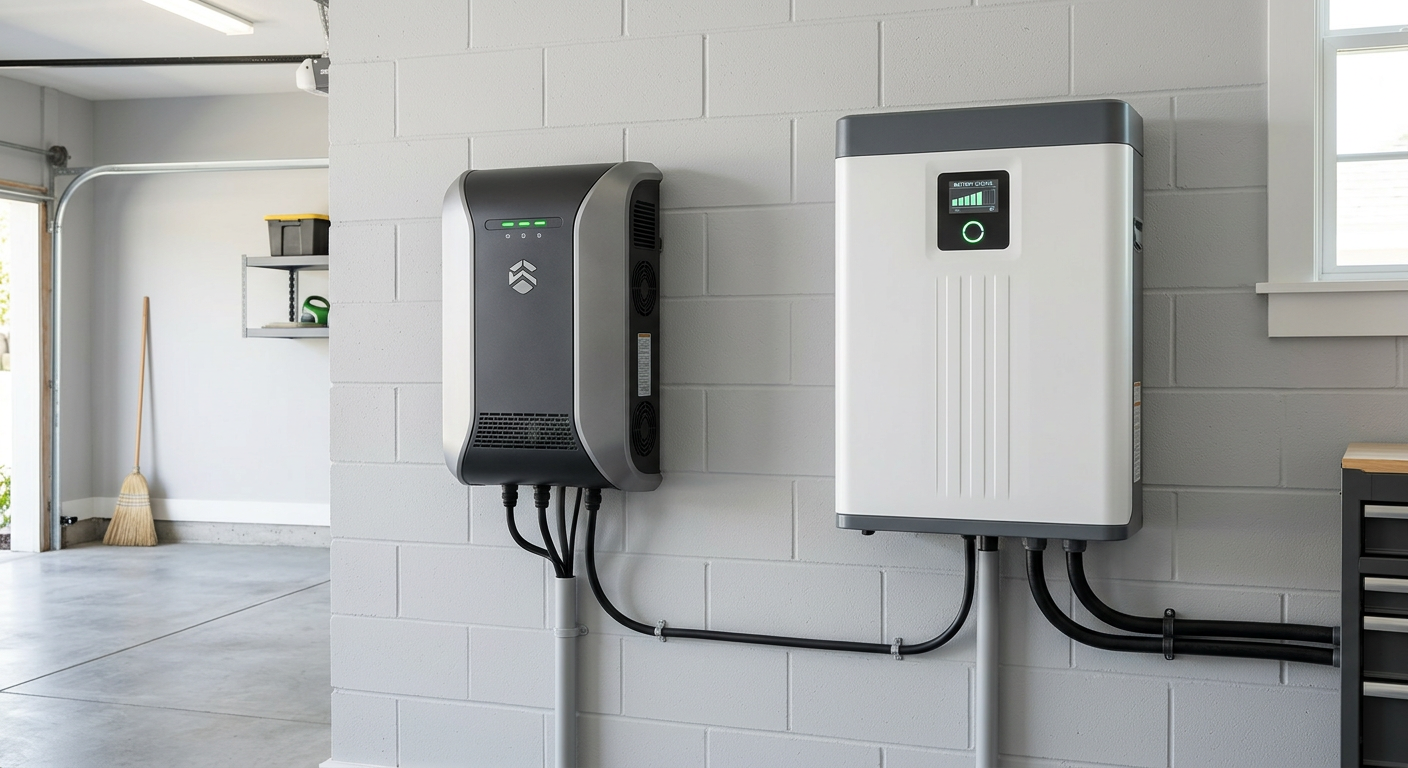
The Tesla Powerwall and Enphase IQ Battery are the two most popular residential battery storage systems in the United States. Together, they account for roughly 70 percent of the home battery market. Both are excellent products from well-established companies, but they take fundamentally different approaches to home energy storage.
As both a Tesla Certified Installer and Enphase Platinum Installer, ProGreen Solar installs both systems regularly. This comparison is based on our hands-on experience with hundreds of installations of each product, not just marketing specifications. We will help you understand which system fits your home, budget, and energy goals.
The Fundamental Difference
Before diving into specifications, understand the core philosophical difference:
Tesla Powerwall 3 is a high-capacity, high-power, all-in-one unit with an integrated solar inverter. One box does everything — storing energy, converting solar DC to AC, and managing backup power. It is designed for whole-home backup from a single unit.
Enphase IQ Battery 5P is a modular building block. Each unit is a relatively small 5 kWh battery that you can stack together in groups of one to twelve or more. It is designed to scale precisely to your needs, starting small and growing over time.
These different approaches lead to different strengths and trade-offs across every comparison dimension.
Specifications Compared
| Feature | Tesla Powerwall 3 | Enphase IQ Battery 5P |
|---|---|---|
| Usable capacity | 13.5 kWh | 5.0 kWh per unit |
| Continuous power | 11.5 kW | 3.84 kW per unit |
| Peak power | 185A at 240V | 7.68 kVA per unit |
| Round-trip efficiency | 97.5% | 96% |
| Integrated inverter | Yes (11.5 kW solar) | No (AC-coupled) |
| Chemistry | NMC (lithium-ion) | LFP (lithium iron phosphate) |
| Warranty | 10 years, unlimited cycles | 15 years or 4,000 cycles |
| Operating temp range | -4°F to 122°F | -4°F to 122°F |
| Weight | 287 lbs | 132 lbs per unit |
| Dimensions | 43.25" x 24" x 7.6" | 42.13" x 18.58" x 7.52" |
| Scalability | Up to 4 units (54 kWh) | Up to 12+ units (60+ kWh) |
| Installation | Wall or floor mount | Wall mount |
Capacity and Power
Capacity
A single Powerwall 3 provides 13.5 kWh of storage — enough to power an average home for 10 to 14 hours under moderate load. To match this with Enphase, you need three IQ Battery 5P units (15 kWh total).
For homeowners wanting 10+ kWh of storage, the Powerwall offers more capacity in a single unit. For homeowners who only need 5 to 10 kWh, Enphase allows you to purchase exactly what you need without overpaying.
Winner: Depends on your needs. Powerwall for large capacity needs; Enphase for precise sizing.
Power Output
This is the Powerwall's most dominant advantage. At 11.5 kW continuous, a single Powerwall 3 can run virtually any combination of home appliances simultaneously — including air conditioning, electric ranges, EV chargers, and electric dryers.
A single Enphase IQ 5P provides only 3.84 kW continuous, which is sufficient for essential loads (lights, refrigerator, internet, phone charging) but cannot run heavy appliances like central air conditioning or electric cooking simultaneously. You need three Enphase units (11.5 kW combined) to match a single Powerwall's power output.
Winner: Tesla Powerwall, decisively. For whole-home backup, a single Powerwall outperforms even two Enphase units in power delivery. See our whole-home vs. partial backup guide for detailed load analysis.
Battery Chemistry
Tesla: NMC
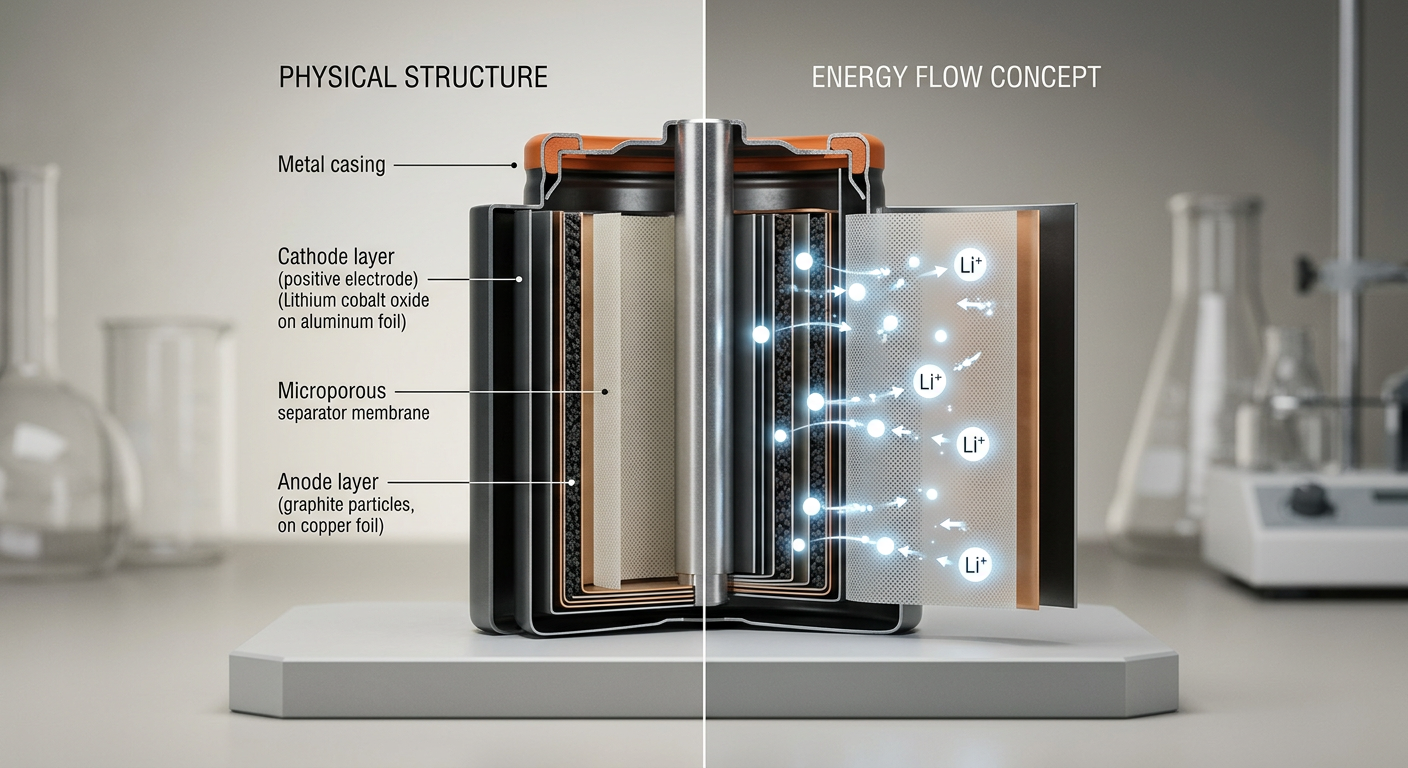
The Powerwall uses Nickel Manganese Cobalt (NMC) lithium-ion cells. NMC offers high energy density (more kWh per pound) and excellent round-trip efficiency. The trade-off is a somewhat shorter cycle life compared to LFP and the environmental concerns of cobalt mining.
Enphase: LFP
The IQ Battery uses Lithium Iron Phosphate (LFP) cells. LFP offers superior thermal stability (inherently safer), longer cycle life (supporting the 15-year warranty), and no cobalt. The trade-off is lower energy density (larger, heavier per kWh) and slightly lower round-trip efficiency.
For a complete explanation of battery chemistry, see our article on how solar batteries work.
Winner: Enphase (LFP) for longevity and safety. Tesla (NMC) for energy density and efficiency.
Warranty
Tesla: 10 Years, Unlimited Cycles
Tesla warrants the Powerwall for 10 years with no limit on the number of charge-discharge cycles. The battery is guaranteed to retain at least 70 percent of its original capacity at year 10. Unlimited cycling means you can use the battery aggressively for TOU rate arbitrage without voiding the warranty.
Enphase: 15 Years or 4,000 Cycles
Enphase offers the longest warranty in the industry at 15 years, with a 4,000-cycle limit. The battery is guaranteed to retain at least 70 percent capacity. At one cycle per day, 4,000 cycles lasts about 11 years — meaning the cycle limit could be reached before the 15-year warranty period expires.
However, LFP chemistry typically delivers 5,000 to 10,000+ cycles in practice, so reaching the 4,000-cycle limit and experiencing significant degradation is unlikely for most usage patterns.
Winner: Enphase for warranty duration (15 vs. 10 years). Tesla for unlimited cycling freedom.
Cost
Tesla Powerwall 3
- Installed cost: $12,000-$15,000
- Cost per kWh: $889-$1,111/kWh
- After 30% ITC: $8,400-$10,500
Enphase IQ Battery 5P
| Configuration | Total Capacity | Installed Cost | Cost/kWh | After ITC |
|---|---|---|---|---|
| 1 unit | 5 kWh | $5,000-$6,500 | $1,000-$1,300 | $3,500-$4,550 |
| 2 units | 10 kWh | $9,500-$12,000 | $950-$1,200 | $6,650-$8,400 |
| 3 units | 15 kWh | $13,500-$17,000 | $900-$1,133 | $9,450-$11,900 |
Analysis
For equivalent capacity (13.5 kWh Powerwall vs. 15 kWh Enphase with 3 units), the Powerwall is typically less expensive by $1,500 to $2,000. However, Enphase's modular approach lets you start with fewer units and add more later.
If you only need 5 to 10 kWh of storage, a single or double Enphase configuration is significantly less expensive than a Powerwall. There is no "small Powerwall" — it is 13.5 kWh or nothing.
Winner: Tesla for large capacity needs. Enphase for budget-conscious installations or smaller capacity needs.
App and Monitoring
Tesla App
The Tesla app provides:
- Real-time energy flow (solar, battery, home, grid)
- Battery charge percentage
- Historical production and consumption data
- Storm Watch (auto-charges before severe weather)
- Energy scheduling (set charge/discharge preferences)
- Remote control and diagnostics
The Tesla app is clean, visually appealing, and responsive. The energy flow animation makes it easy to understand what is happening at a glance.
Enphase Enlighten
The Enphase Enlighten app provides:
- Real-time energy flow (solar, battery, home, grid)
- Panel-level production monitoring (if using Enphase microinverters)
- Battery charge percentage and state of health
- Historical analytics with detailed graphs
- Storm Guard (similar to Storm Watch)
- EV charger integration (if using Enphase IQ EV Charger)
Enlighten's standout feature is panel-level monitoring when paired with Enphase microinverters. You can see the production of every individual panel, making it easy to identify underperformers, shading issues, or equipment problems.
Winner: Tie. Both apps are excellent. Tesla is slightly more visually polished; Enphase offers deeper panel-level data when paired with their microinverters.
Installation
Tesla Powerwall 3
The Powerwall 3's integrated inverter means your solar panels connect directly to the Powerwall for DC-to-AC conversion. This simplifies new installations (no separate inverter needed) but creates a constraint: you are committed to Tesla's inverter technology.
The Powerwall can be wall-mounted or floor-mounted, indoors or outdoors. At 287 pounds, wall mounting requires a sturdy wall and proper backing. The Backup Gateway (transfer switch) installs near your main panel.
Installation typically takes one to two days for a solar-plus-Powerwall system.
Enphase IQ Battery 5P
Each Enphase unit is AC-coupled, meaning it works with any solar inverter brand. This makes it the natural choice when adding storage to an existing solar system or when using Enphase microinverters.
Each unit weighs 132 pounds and wall-mounts easily. Multiple units can be mounted side by side on the same wall. The IQ System Controller (transfer switch) manages backup circuits.
Installation typically takes one day for a single-unit installation, one to two days for multi-unit systems.
Winner: Enphase for flexibility and ease of adding to existing systems. Tesla for streamlined new installations.
Scalability
Tesla
You can install up to four Powerwall 3 units for a maximum of 54 kWh and 46 kW of continuous power. Each Powerwall is a substantial unit, and adding additional units later requires scheduling a separate installation visit and potentially upgrading electrical components.
Enphase
You can install up to twelve or more IQ Battery 5P units for 60+ kWh. Adding units is relatively straightforward — each new unit connects to the existing system. The modular approach allows you to start with what you can afford and add capacity as your needs or budget grow.
Winner: Enphase, clearly. The modular approach offers unmatched flexibility for growing your storage over time.
Ecosystem Integration
Tesla Ecosystem
The Powerwall 3 integrates with:
- Tesla solar panels (if using Tesla's complete system)
- Tesla app for monitoring and control
- Tesla vehicles (Powerwall can charge from the grid during off-peak and power EV charging during peak)
The Powerwall does not integrate with third-party inverters (like Enphase microinverters or SolarEdge). If you want a different inverter brand, you need the Powerwall 2 (if available) or a different battery.
Enphase Ecosystem
The IQ Battery integrates with:
- Enphase IQ8 microinverters (seamlessly through Enlighten)
- Enphase IQ System Controller
- Enphase IQ EV Charger
- Any third-party inverter (AC-coupled compatibility)
The Enphase ecosystem is broader in compatibility while tighter in integration when you use all Enphase components. The panel-level monitoring through microinverters and whole-home energy management through the System Controller create a cohesive experience.
Winner: Enphase for broad compatibility. Tesla for a fully self-contained system.
Which Is Better for Colorado?
Both batteries perform well in Colorado's climate. Both have operating temperature ranges of -4 to 122 degrees F and active thermal management systems that handle Colorado's temperature extremes.
Specific Colorado considerations:
- Whole-home backup for severe storms: Powerwall's 11.5 kW output handles heavy loads better during extended outages, including running heating systems, refrigerators, and multiple circuits simultaneously.
- Starting small with an option to grow: Enphase's modular approach lets you add one unit now and more later — useful if you want backup but have a limited budget.
- Existing Enphase microinverter system: If you already have Enphase microinverters, the IQ Battery integrates seamlessly. Adding a Powerwall would require replacing your inverter technology.
- Hail and weather concerns: Both batteries are installed inside garages or on protected exterior walls. Weather durability is not a differentiator between them.
For more on Colorado-specific considerations, see our Colorado solar performance guide.
Our Recommendation
Choose the Tesla Powerwall 3 If:
- You want whole-home backup from a single unit
- You are installing a brand-new solar system (no existing inverter)
- You want the highest power output for running heavy loads during outages
- You prefer a single-brand, integrated system
- You need 13.5+ kWh of storage
Choose the Enphase IQ Battery 5P If:
- You want modular, scalable storage (start small, grow later)
- You have an existing solar system with any inverter brand
- You use or plan to use Enphase microinverters
- You want the longest warranty (15 years)
- You prioritize LFP battery chemistry for longevity and safety
- You need less than 13.5 kWh initially and want to add more later
- Budget requires a lower entry point ($5,000-$6,500 for one unit)
The Best Choice Is the Right Choice for You
There is no universally "better" battery. The best choice depends on your specific needs, existing equipment, budget, and priorities. At ProGreen Solar, we install both systems and recommend the option that genuinely fits your situation.
Get a Personalized Battery Recommendation
Use our solar calculator to explore solar-plus-storage options, or call (303) 484-1410 to discuss your battery needs with our team. We will evaluate your home's energy usage, backup requirements, and existing equipment to recommend the right battery system — whether that is a Tesla Powerwall, Enphase IQ Battery, or something else entirely.