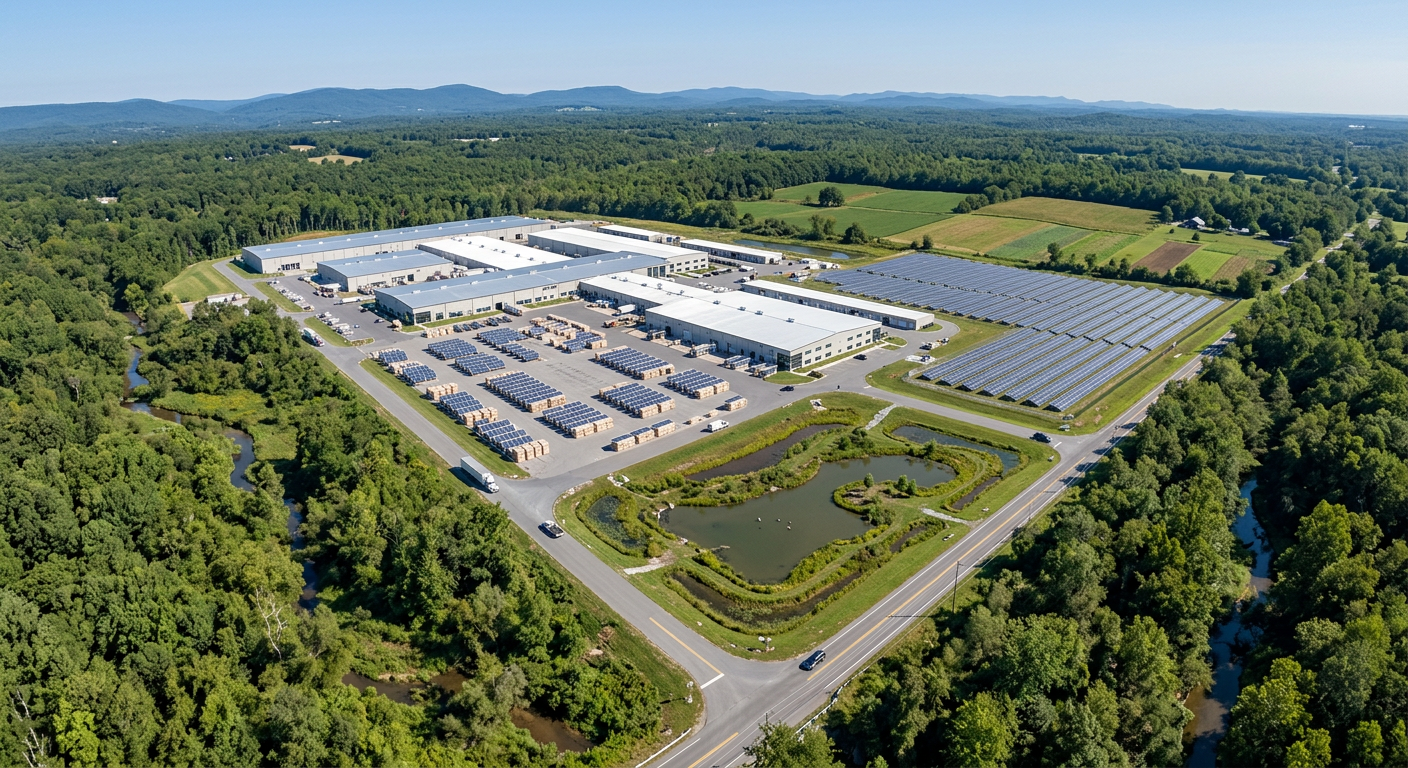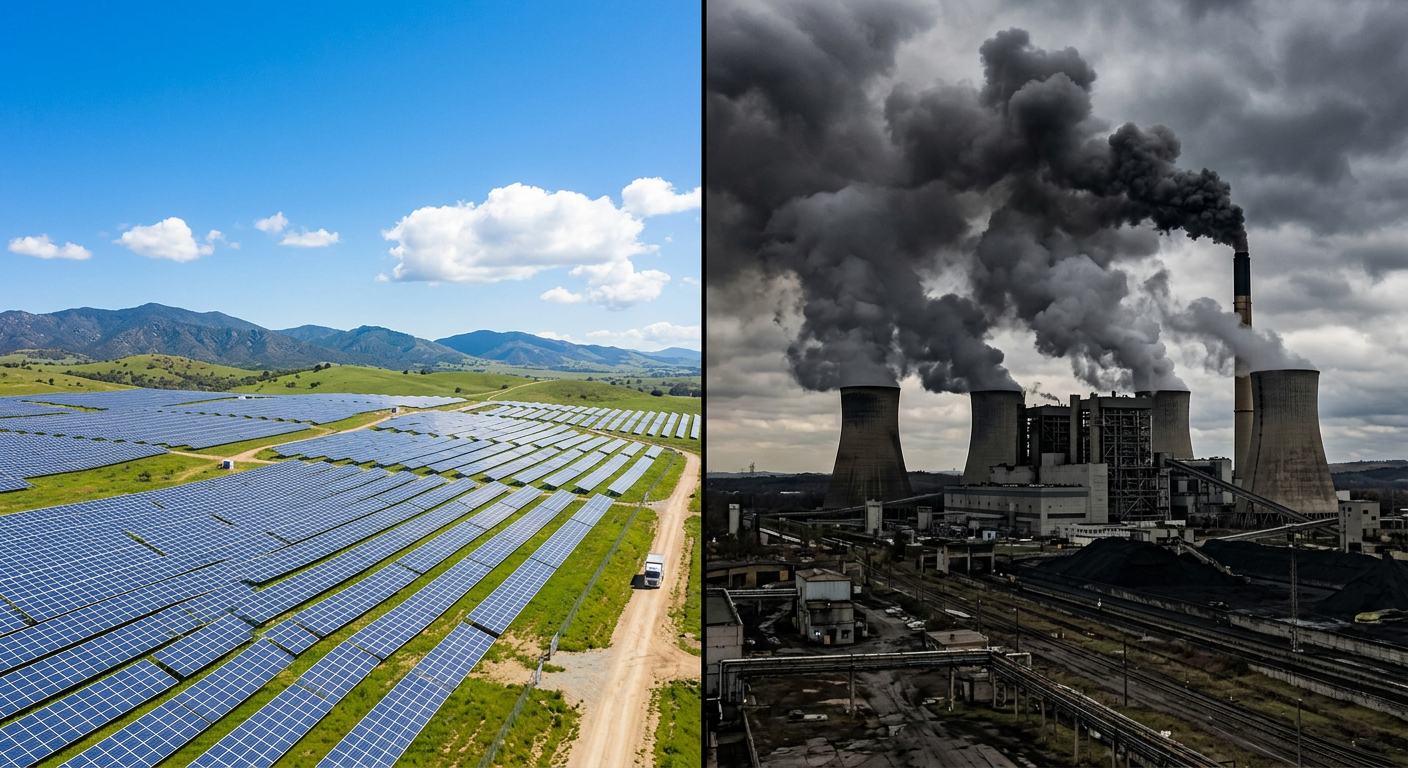
The environmental comparison between solar energy and fossil fuels is not a close contest. Across virtually every measurable metric — carbon emissions, air pollution, water consumption, land disturbance, health impacts, and waste generation — solar energy dramatically outperforms coal, natural gas, and oil.
But the conversation deserves nuance. Solar energy is not impact-free: panels require manufacturing energy, occupy land area, and generate end-of-life waste. Presenting an honest, comprehensive comparison is more persuasive than pretending solar has zero impact. At ProGreen Solar, we believe the data speaks for itself when presented fairly.
This guide compares solar and fossil fuels across every major environmental metric, using peer-reviewed data and real-world measurements.
Carbon Emissions: The Headline Comparison
Carbon dioxide emissions are the most discussed environmental metric, and solar's advantage is overwhelming:
Lifecycle Emissions per kWh
| Energy Source | Lifecycle CO2 (g/kWh) | Multiple vs. Solar |
|---|---|---|
| Coal | 820 - 1,200 | 20-40x more |
| Natural gas (combined cycle) | 410 - 520 | 10-17x more |
| Natural gas (peaker) | 550 - 750 | 14-25x more |
| Oil | 650 - 890 | 16-30x more |
| Solar PV (rooftop) | 30 - 65 | Baseline |
| Wind | 7 - 15 | 0.2-0.5x (even less) |
| Nuclear | 5 - 20 | 0.1-0.7x (even less) |
These are lifecycle numbers — they include everything from fuel extraction and equipment manufacturing through operation and decommissioning. Solar's 30 to 65 grams per kWh accounts for the full manufacturing carbon footprint of panels, inverters, and mounting equipment.
Solar generates 10 to 40 times less carbon per kWh than fossil fuels when all lifecycle impacts are included.
What the Numbers Mean for Colorado
Colorado's electricity grid produces approximately 0.45 kg CO2 per kWh — heavily influenced by remaining coal and natural gas generation. Every kilowatt-hour generated by your rooftop solar system displaces that grid electricity and its associated emissions.
A typical 7 kW residential system in Colorado prevents approximately 5 metric tons of CO2 annually — the equivalent of taking one gasoline car off the road.
Air Quality and Health Impacts
Beyond carbon dioxide, fossil fuel combustion releases a cocktail of air pollutants with direct health impacts:
Pollutants from Fossil Fuel Electricity
Sulfur dioxide (SO2): Primarily from coal combustion. Causes acid rain, damages ecosystems, and triggers respiratory illness. Coal plants emit 1 to 6 grams of SO2 per kWh; solar emits zero during operation.
Nitrogen oxides (NOx): From both coal and natural gas combustion. Contributes to smog and ground-level ozone — a persistent problem along Colorado's Front Range. Natural gas plants emit 0.2 to 0.5 grams per kWh; coal emits 1 to 3 grams per kWh; solar emits zero.
Particulate matter (PM2.5): Fine particles that penetrate deep into lungs and enter the bloodstream, causing heart attacks, strokes, lung cancer, and premature death. The American Lung Association estimates that fossil fuel air pollution causes approximately 50,000 premature deaths per year in the United States.
Mercury: Coal plants are the largest industrial source of mercury emissions in the US. Mercury is a potent neurotoxin that accumulates in fish and poses particular risks to pregnant women and children. Solar produces zero mercury emissions.
Volatile organic compounds (VOCs): Released during natural gas extraction, processing, and combustion. Contribute to ozone formation and have direct toxic effects.
The Health Cost of Fossil Fuel Electricity
Researchers have quantified the health costs of air pollution from fossil fuel electricity:
| Source | Health Cost per kWh |
|---|---|
| Coal | $0.02 - $0.15 |
| Natural gas | $0.005 - $0.03 |
| Solar | ~$0.00 |
These costs reflect increased healthcare spending, lost productivity, and premature mortality. The true cost of fossil fuel electricity is significantly higher than what appears on your bill — the health impacts are paid through insurance premiums, Medicare, and shortened lives.
Nationally, the health damage from fossil fuel electricity generation is estimated at $75 to $200 billion per year. Solar eliminates these costs entirely.
Colorado's Air Quality Challenge
Colorado's Front Range is classified as a nonattainment area for federal ozone standards, meaning air quality regularly fails to meet health-based limits. Vehicle emissions are the primary source, but power plant emissions contribute significantly.
Every solar installation that reduces fossil fuel generation helps improve Colorado's air quality. When you combine solar with an electric vehicle, the air quality benefit doubles — eliminating both power plant and tailpipe emissions.
Water Consumption
Water is a critical and often overlooked environmental metric, particularly in the arid West.
Water Use by Energy Source
| Energy Source | Water Consumption (gallons/kWh) |
|---|---|
| Coal (once-through cooling) | 20-50 |
| Coal (recirculating cooling) | 0.4-0.7 |
| Natural gas (combined cycle) | 0.1-0.3 |
| Nuclear | 0.4-0.8 |
| Solar PV | 0 (operation); 0.02-0.05 (panel washing) |
| Concentrated solar (CSP) | 0.6-1.0 |
Rooftop solar PV uses essentially zero water during operation. In arid Colorado, where water is precious and increasingly contested, this is a significant advantage.
A 7 kW solar system displacing grid electricity saves approximately 5,000 to 10,000 gallons of water per year that would otherwise be consumed by power plant cooling. Over 30 years, that is 150,000 to 300,000 gallons — enough to fill a medium-sized swimming pool five to ten times over.
Occasionally cleaning solar panels uses minimal water — roughly 10 to 20 gallons per year for a residential system. Learn more about how to clean solar panels.
Land Use
Land use is one metric where critics often challenge solar energy. Let us examine it honestly.
Direct Land Footprint
Rooftop solar: Uses zero additional land. Panels are installed on existing rooftops that would otherwise serve no energy purpose. This is the most land-efficient form of electricity generation because it uses space that is already developed.
Utility-scale solar farms: Require 5 to 10 acres per megawatt, or approximately 35 to 75 square miles for a 1,000 MW facility. This is significant but must be contextualized.
Coal mining: Surface coal mining disturbs approximately 0.1 to 0.5 acres per GWh of electricity produced over the mine's lifetime. In Appalachia alone, mountaintop removal mining has destroyed over 500 peaks and buried 2,000 miles of streams.
Natural gas: Including well pads, access roads, pipelines, compressor stations, and processing facilities, natural gas infrastructure covers substantial acreage. In Colorado, oil and gas well pads are visible across the Front Range and Western Slope.
Land Disruption Quality
Not all land use is equal. The type of disruption matters:
Solar farms sit lightly on the land. Panels are mounted on posts driven into the ground with minimal excavation. The land beneath and between panels can support native grasses, pollinator habitat, or even grazing (known as "agrivoltaics"). When solar farms are decommissioned, the land returns to its original state with minimal remediation.
Coal mining permanently alters landscapes. Mountaintop removal, open-pit mining, and underground mining cause irreversible topographic and ecological damage. Acid mine drainage contaminates waterways for decades or centuries after mining ceases.
Oil and gas drilling creates permanent industrial infrastructure: well pads, roads, pipelines, and waste pits. Hydraulic fracturing (fracking) has contaminated groundwater in documented cases and creates ongoing disposal challenges for produced water.
For rooftop solar, the land use advantage is absolute — you generate electricity from space that is already built, with zero additional land disturbance.
Waste Generation
Solid Waste Comparison
| Source | Waste per GWh | Waste Type |
|---|---|---|
| Coal | 120-150 tons of ash, 1.5 tons of scrubber sludge | Toxic (arsenic, mercury, lead, cadmium) |
| Natural gas | Minimal solid waste | Produced water (contaminated), pipeline waste |
| Nuclear | 0.003 tons of spent fuel | Highly radioactive, dangerous for 10,000+ years |
| Solar | 0.05 tons of panel materials (at end of life) | Non-toxic, 95%+ recyclable |
Coal ash is the second-largest industrial waste stream in the US after mining waste. Over 100 million tons are produced annually, stored in unlined ponds and landfills, and have caused catastrophic environmental disasters (the 2008 Kingston, Tennessee spill released 5.4 million cubic yards of toxic slurry).
Solar panels at end of life are highly recyclable, recovering 95 percent or more of materials. They contain no hazardous materials (crystalline silicon panels), and the total waste volume over 30 years of operation is minimal.
Carbon Waste (CO2)
The most significant "waste" from fossil fuels is invisible: carbon dioxide released into the atmosphere. Unlike solid waste that can theoretically be contained, atmospheric CO2 disperses globally and persists for centuries.
A single coal plant operating for one year releases millions of tons of CO2 — waste that cannot be recalled, contained, or recycled. It changes the atmospheric composition permanently on human timescales.
Solar produces zero atmospheric waste during 25 to 35 years of operation.
Ecosystem and Biodiversity Impacts
Fossil Fuel Ecosystem Damage
- Oil spills — The Deepwater Horizon disaster released 210 million gallons of oil, devastating marine ecosystems across thousands of square miles
- Coal mining — Destroys terrestrial habitat, contaminates waterways, eliminates entire stream ecosystems
- Fracking — Potential groundwater contamination, habitat fragmentation from well pads and roads, noise and light pollution affecting wildlife
- Climate change — Fossil fuel emissions drive global temperature increases, causing mass coral bleaching, species range shifts, extreme weather, and ocean acidification
Solar Ecosystem Impact
- Rooftop solar — Essentially zero ecosystem impact (installed on existing structures)
- Utility-scale solar — Can displace habitat if built on undeveloped land, but mitigation strategies (pollinator-friendly ground cover, wildlife corridors, agrivoltaics) can maintain or even enhance local ecosystems
- Manufacturing — Mining impacts for raw materials, though far smaller than continuous fossil fuel extraction
Solar's ecosystem impact is not zero, but it is orders of magnitude smaller than fossil fuels, especially when considering the existential threat that climate change poses to global ecosystems.
The Full-Picture Comparison
Here is the comprehensive scorecard:
| Metric | Solar PV | Coal | Natural Gas |
|---|---|---|---|
| CO2 emissions | 30-65 g/kWh | 820-1,200 g/kWh | 410-520 g/kWh |
| SO2 emissions | 0 | 1-6 g/kWh | Trace |
| NOx emissions | 0 | 1-3 g/kWh | 0.2-0.5 g/kWh |
| Mercury emissions | 0 | Significant | Trace |
| Water consumption | ~0 | 0.4-50 gal/kWh | 0.1-0.3 gal/kWh |
| Land disturbance (rooftop) | 0 additional | Mining + plant site | Wells + pipelines |
| Solid waste | Recyclable at EOL | Toxic ash (ongoing) | Produced water |
| Health costs | ~$0/kWh | $0.02-$0.15/kWh | $0.005-$0.03/kWh |
| Fuel required | Sunlight (free) | Continuous mining | Continuous drilling |
| Climate impact | Negligible | Severe | Significant |
The Economic Intersection
Environmental superiority matters more when it comes with economic advantages — and in 2026, it does. Solar is now the cheapest new electricity source in most of the world, including Colorado. The levelized cost of energy (LCOE) for rooftop solar in Colorado is approximately $0.04 to $0.07 per kWh — competitive with wholesale natural gas and far cheaper than retail electricity.
When you add the hidden health, environmental, and climate costs to fossil fuel electricity, the true cost comparison is not even close. The "cheap" fossil fuel electricity that costs $0.14 per kWh on your bill actually costs society $0.16 to $0.29 per kWh when externalities are included.
Solar provides cheaper, cleaner electricity with none of those hidden costs.
What You Can Do
Every rooftop solar installation shifts the balance from fossil fuels toward clean energy. The environmental benefit compounds: more solar means less fossil fuel generation, which means less pollution, less water consumption, less mining, and less climate impact.
At ProGreen Solar, we install systems that make both financial and environmental sense. Use our solar calculator to see your personal environmental impact numbers alongside your financial savings, or call (303) 484-1410 to start your transition away from fossil fuel electricity. The environmental case for solar is as strong as the financial case — and both point in the same direction.