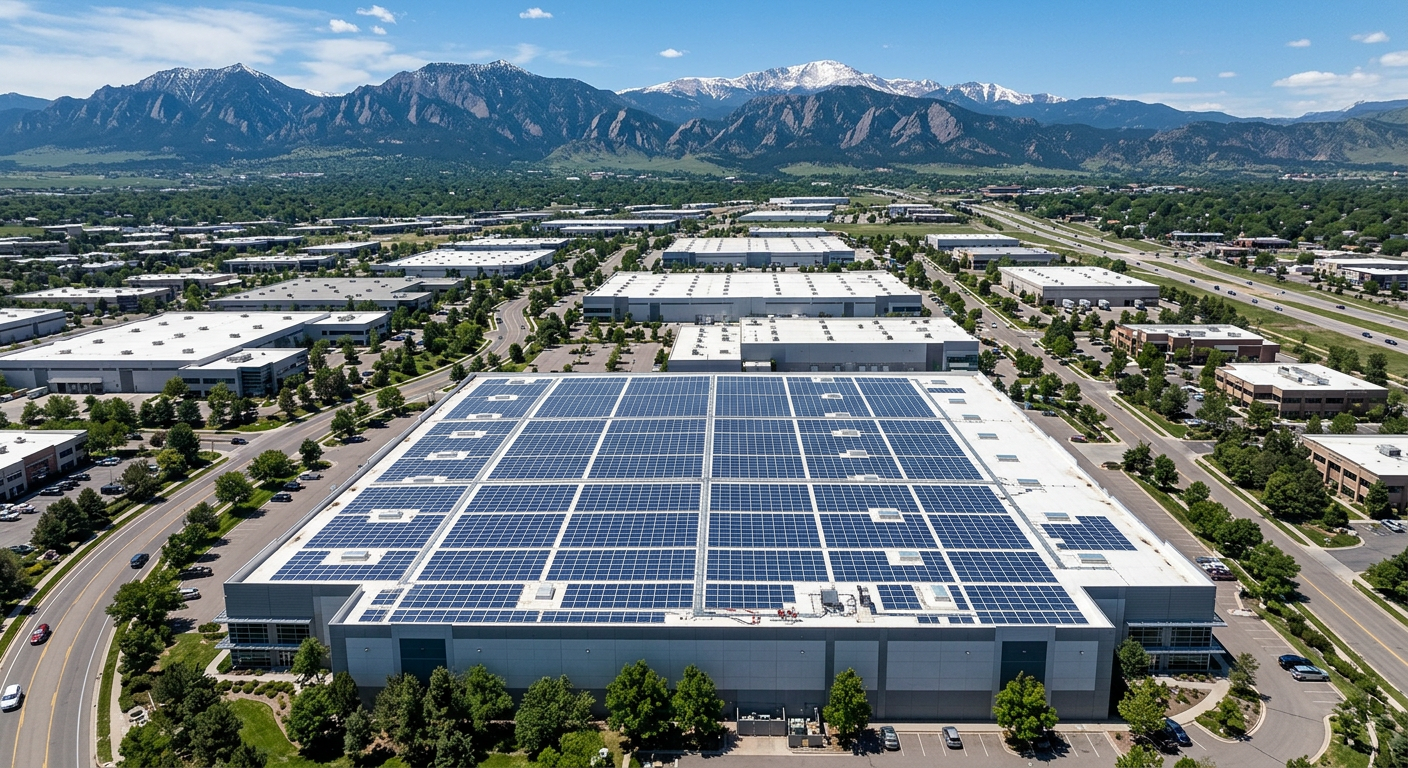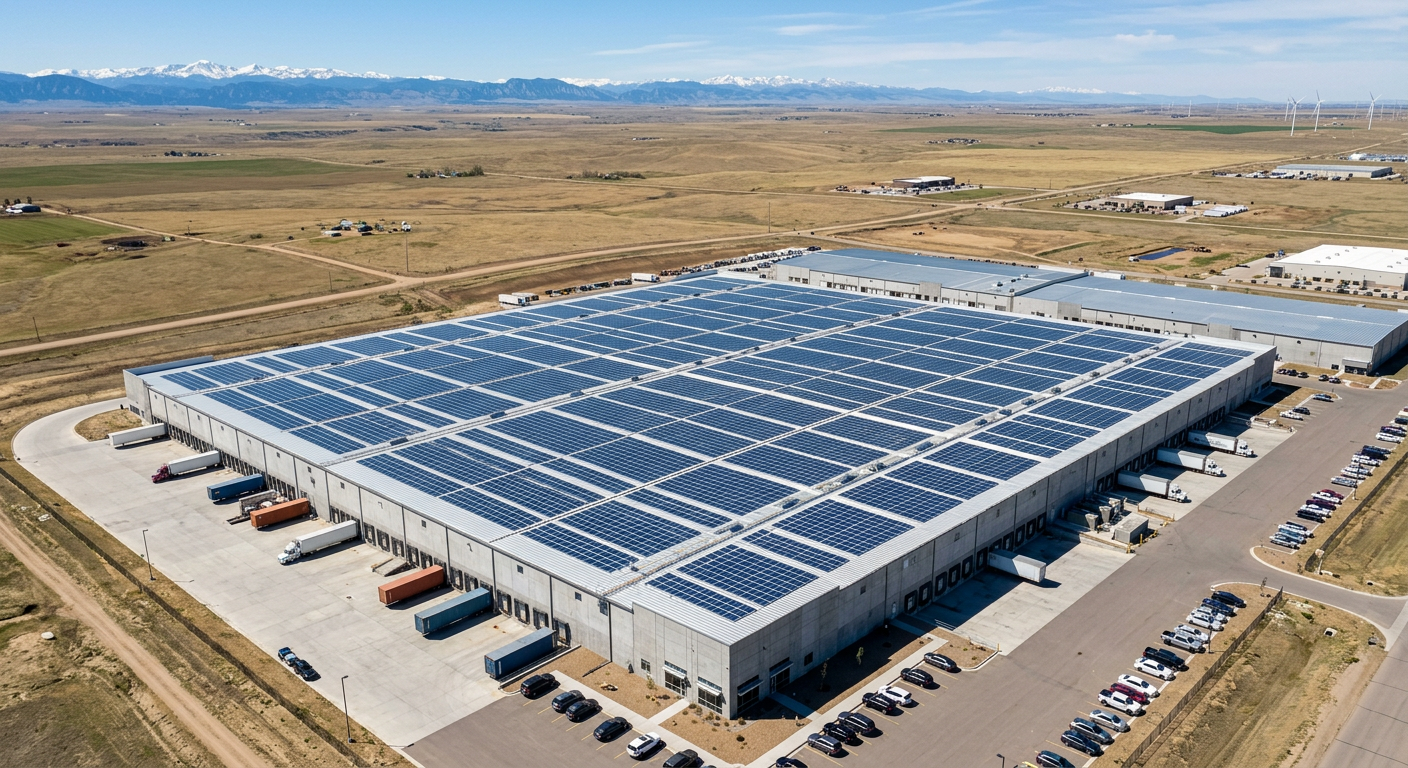
Warehouses and industrial buildings represent the ideal canvas for commercial solar installations. Their defining features — large, flat, unobstructed rooftops and high electricity consumption — align perfectly with what solar needs to deliver maximum financial returns. If your business operates from a warehouse, distribution center, manufacturing facility, or industrial building in Colorado, you are sitting on one of the best solar opportunities available.
At ProGreen Solar, commercial and industrial installations are among our most rewarding projects because the economics are so strong. Systems on large flat roofs routinely achieve payback periods of three to six years with lifetime returns exceeding 500 percent. This guide covers the specifics of solar for warehouses and industrial buildings.
Why Warehouses Are Ideal for Solar
Massive Unobstructed Roof Space
The average warehouse roof provides 20,000 to 100,000 square feet of usable space — enough for 100 kW to 1 MW or more of solar capacity. Unlike residential roofs with dormers, chimneys, vent pipes, and complex geometry, warehouse roofs are typically:
- Flat or very low slope (making solar panel layout efficient)
- Free of shading (tall buildings without nearby obstructions)
- Oriented as simple rectangles (maximizing usable area)
- Structurally designed for rooftop equipment loads
A warehouse with just 20,000 square feet of usable roof can accommodate approximately 125 kW of solar — generating 200,000 kWh per year in Colorado. A 100,000-square-foot roof can support 600 kW or more.
High Daytime Energy Consumption
Warehouses and industrial facilities typically consume the most electricity during business hours — precisely when solar panels produce the most power. This alignment maximizes self-consumption and minimizes the need for grid interaction.
Typical warehouse energy loads include:
- Lighting (often the largest load) — 3 to 8 watts per square foot
- HVAC — heating, cooling, and ventilation for climate control
- Material handling equipment — forklifts, conveyors, dock equipment
- Refrigeration (cold storage facilities) — extremely energy-intensive
- Compressed air systems — 20 to 30 percent of many industrial facilities' electricity
- Office areas — computers, lighting, climate control
Demand Charge Vulnerability
Industrial electricity rates typically include significant demand charges — $10 to $25 per kW based on peak 15-minute power draw. A warehouse with a 200 kW peak demand might pay $2,000 to $5,000 per month in demand charges alone.
Solar combined with battery storage can shave peak demand substantially, directly reducing these charges. A 100 kW solar system with a 50 kWh battery can reduce peak demand by 40 to 80 kW, saving $400 to $2,000 per month in demand charges on top of energy savings.
System Sizing for Industrial Buildings
Sizing Approach
We size commercial systems based on three factors:
1. Available roof space — How much solar can physically fit on the roof after accounting for setbacks (required clear zones around roof edges and obstructions), HVAC equipment, access pathways for maintenance, and structural limitations.
2. Annual electricity consumption — How much energy the facility uses. Ideally, the solar system produces 70 to 100 percent of annual consumption. Producing more than 100 percent can reduce the financial return because excess generation may be compensated at lower wholesale rates.
3. Utility interconnection limits — Utilities may limit the size of systems that can interconnect to their distribution network. Systems above certain thresholds require additional engineering studies and potentially grid infrastructure upgrades.
Typical Industrial System Sizes
| Building Size | Usable Roof | System Size | Annual Production | Annual Savings* |
|---|---|---|---|---|
| 10,000 sq ft | 7,500 sq ft | 50 kW | 80,000 kWh | $10,000-$14,000 |
| 25,000 sq ft | 18,000 sq ft | 115 kW | 184,000 kWh | $23,000-$32,000 |
| 50,000 sq ft | 37,000 sq ft | 230 kW | 368,000 kWh | $46,000-$64,000 |
| 100,000 sq ft | 75,000 sq ft | 470 kW | 752,000 kWh | $94,000-$130,000 |
| 200,000 sq ft | 150,000 sq ft | 940 kW | 1,504,000 kWh | $188,000-$260,000 |
*Savings range reflects variation in electricity rates and demand charge structures.
Mounting Systems for Flat Commercial Roofs
Flat roofs require specialized mounting systems different from residential pitched-roof installations:
Ballasted Systems
Ballasted racking uses weighted blocks (typically concrete) to hold panels in place without penetrating the roof membrane. This is the preferred method for most commercial flat roofs because:
- Preserves roof warranty by avoiding penetrations
- Faster installation (no drilling or attachment to structure)
- Easier to remove or reposition panels if needed
- Compatible with TPO, EPDM, PVC, and modified bitumen roofs
Panels are typically tilted 5 to 15 degrees on ballasted racks — enough to improve production and promote water runoff without creating excessive wind uplift. The total weight (panels plus ballast) is approximately 3 to 5 pounds per square foot.
Mechanically Attached Systems
For roofs where ballast weight is a concern or wind conditions are severe, mechanically attached systems anchor racking directly to the roof structure through the membrane. These systems:
- Weigh less than ballasted systems (2 to 3 pounds per square foot)
- Provide greater wind resistance
- Require careful coordination with roofing contractors to maintain membrane warranty
- May include elevated flashing details for waterproofing
Ground-Mount Systems
When roof space is insufficient or the roof cannot support solar, ground-mounted systems on adjacent land are an excellent alternative:
- No roof structural concerns
- Optimal tilt angle and orientation (not constrained by existing roof angle)
- Easier maintenance access
- Can be built to any size (limited only by available land and interconnection capacity)
- Typically cost 10 to 20 percent more per watt than rooftop due to foundation and land preparation costs
A single acre of land in Colorado can support approximately 200 to 300 kW of ground-mounted solar.
Roof Condition and Solar
Assess Before You Install
The most critical pre-installation consideration for warehouse solar is roof condition. Solar panels will be on the roof for 25 to 35 years. Removing panels for a roof replacement during that period is expensive and disruptive.
Our recommendation: If your roof has fewer than 10 years of remaining life, re-roof before installing solar. If it has 10 to 15 years remaining, consider re-roofing — the combined project can be more cost-effective than two separate projects.
Roofing and solar synergy: Cool roof coatings (white or highly reflective membranes) paired with solar panels improve both the roof's thermal performance and the panels' efficiency. The reflective roof bounces additional light onto the panels' underside (beneficial for bifacial panels) while solar panels shade the roof membrane, extending its life.
Structural Assessment
Not all warehouse roofs can support solar without modification. Our engineering team evaluates:
- Dead load capacity — Can the structure support the additional 3 to 5 pounds per square foot?
- Live load interaction — Solar reduces available live load capacity; snow loads in Colorado must be accounted for
- Wind load — Panels create additional wind uplift forces that the structure must resist
- Seismic considerations — Minimal for Colorado but still evaluated per code
Most modern warehouse construction (steel frame with metal or membrane roofing) is designed with sufficient capacity for solar. Older wood-frame or masonry buildings may require structural reinforcement — typically $1 to $3 per square foot.
Financial Analysis for Industrial Solar
Investment Tax Credit
The 30 percent ITC applies to commercial systems of all sizes. For systems 1 MW and above, prevailing wage and apprenticeship requirements must be met for the full 30 percent rate. Additional bonus adders for domestic content and energy communities can push the effective credit to 40 to 50 percent.
MACRS Depreciation
The 5-year MACRS depreciation schedule provides substantial additional tax benefits. Combined with the ITC, total tax benefits typically equal 50 to 65 percent of system cost.
Example: 250 kW Warehouse System
| Item | Amount |
|---|---|
| System cost (250 kW at $1.80/W) | $450,000 |
| ITC (30%) | -$135,000 |
| MACRS tax savings (24% bracket) | -$75,600 |
| Net cost | $239,400 |
| Annual energy savings | $46,000 |
| Annual demand charge savings (with battery) | $12,000 |
| Total annual savings | $58,000 |
| Payback period | 4.1 years |
| 25-year total savings | $1,900,000+ |
| 25-year ROI | 694% |
Special Considerations for Industrial Facilities
Three-Phase Power
Most industrial buildings have three-phase electrical service, which is advantageous for solar. Three-phase inverters are more efficient and cost-effective at commercial scale, and the existing electrical infrastructure can often accommodate solar interconnection without significant upgrades.
Cold Storage and Refrigeration
Cold storage warehouses are among the best candidates for solar because:
- Extremely high electricity consumption (10 to 20 kWh per square foot per year versus 3 to 8 for standard warehouses)
- Relatively constant load profile that aligns well with solar production
- Cooling loads peak in summer when solar production peaks
- Very high electricity bills create very high savings
A 50,000-square-foot cold storage facility might consume 500,000 to 1,000,000 kWh per year — supporting a 300 to 600 kW solar system with exceptional financial returns.
Manufacturing Operations
Manufacturing facilities with large electrical loads (motors, compressors, process heating) often have demand charges that dominate their electricity bills. Solar-plus-battery systems can optimize both energy and demand charges, delivering combined savings that accelerate payback.
Multi-Tenant Buildings
Warehouse parks and industrial complexes with multiple tenants present unique opportunities:
- Building owners can install solar and allocate electricity savings to tenants through virtual net metering or tenant billing arrangements
- Solar can be a competitive advantage for attracting and retaining tenants
- Common area and shared loads (lighting, landscaping, building management) can be powered by solar
Operations and Maintenance
Commercial solar systems require minimal maintenance but benefit from a proactive monitoring and maintenance program:
- Production monitoring — Continuous monitoring identifies performance issues immediately. Both Enphase and SolarEdge offer commercial-grade monitoring platforms.
- Annual inspection — Visual inspection of panels, wiring, and mounting hardware. Check for damage, debris, and vegetation shading.
- Panel cleaning — Colorado's dusty conditions may warrant annual or semi-annual cleaning. For large systems, professional cleaning services cost $0.05 to $0.15 per watt and can recover 2 to 5 percent of lost production.
- Inverter maintenance — String inverters have 10 to 15 year warranties; microinverters and power optimizers carry 25 year warranties. Budget for inverter replacement at the midpoint for string inverter systems.
ProGreen Solar offers commercial O&M packages that include monitoring, annual inspections, cleaning, and warranty management.
Getting Started with Industrial Solar
The process for industrial solar projects at ProGreen Solar begins with a no-cost site assessment:
- Electricity bill analysis — We review 12 months of bills to understand consumption patterns, demand profiles, and rate structures
- Roof/site evaluation — Engineering assessment of structural capacity, roof condition, electrical infrastructure, and shading
- System design — Optimized layout for maximum production and financial return
- Financial modeling — Detailed cash flow analysis including ITC, MACRS, energy savings, demand reduction, and financing costs
- Proposal review — Clear presentation of options, costs, returns, and timelines
Most commercial projects from initial contact to operational system take 3 to 6 months, depending on system size, permitting complexity, and utility interconnection timelines.
Maximize Your Commercial Solar ROI
Your warehouse or industrial building's roof is a revenue-generating asset waiting to be activated. With Colorado's 300 days of sunshine, strong tax incentives, and rising commercial electricity rates, the question is not whether commercial solar makes sense — it is how much money you are losing each month by waiting.
Call ProGreen Solar at (303) 484-1410 for a free commercial site assessment, or use our solar calculator for a preliminary estimate. We will show you exactly how much your building can save — and how quickly the investment pays for itself.