If you are researching solar installations, you have probably encountered the term "power optimizer" — a small electronic device that attaches to each solar panel in your system. Power optimizers sit at the intersection of two different solar architectures: the simplicity of string inverters and the panel-level control of microinverters. Understanding what they do and when they are worth the investment will help you make a better decision about your solar system design.
What Is a Power Optimizer?
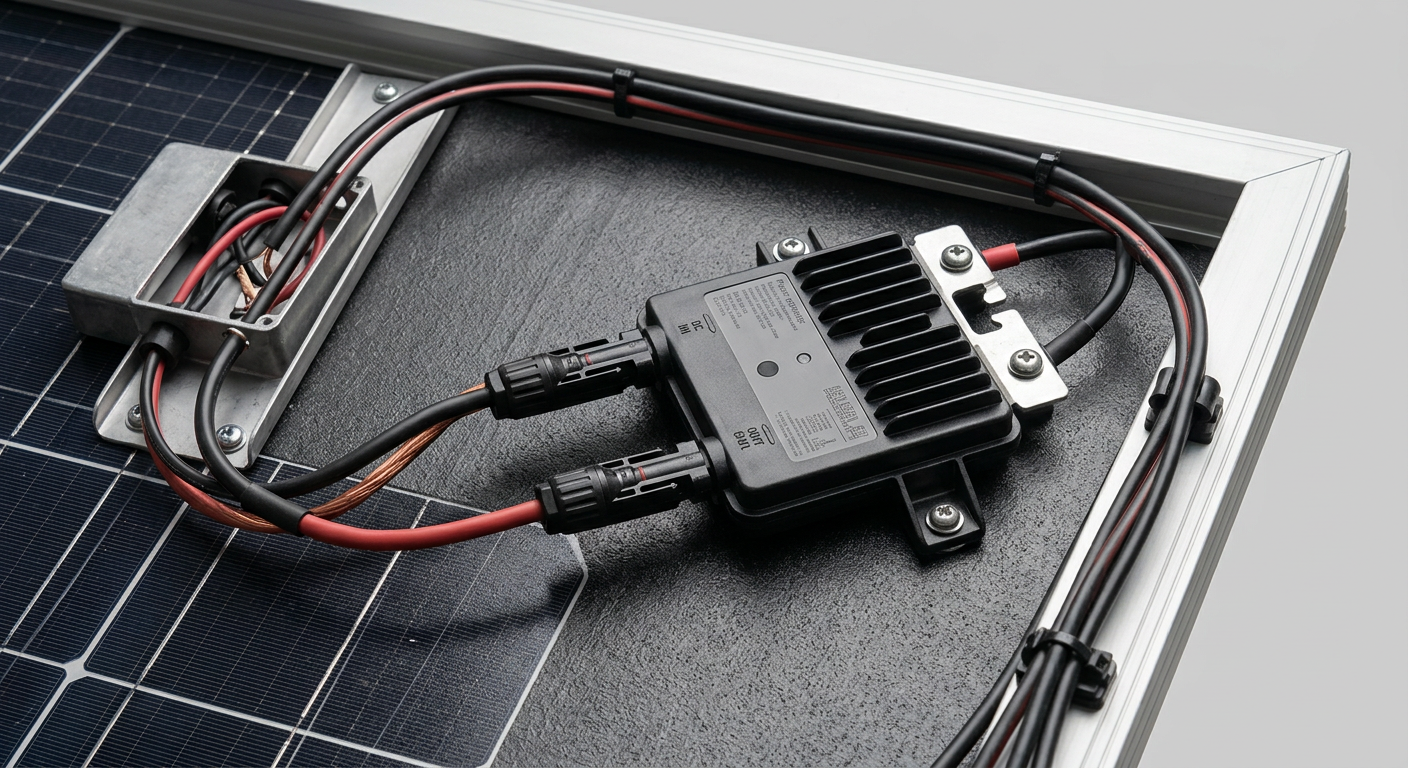
A power optimizer is a DC-to-DC converter installed on or near each solar panel. It conditions the DC electricity from that panel before sending it along the string to a centralized string inverter, which performs the final DC-to-AC conversion.
In simpler terms: the optimizer makes sure each panel contributes its maximum possible output to the string, regardless of what is happening to other panels in the same string.
How They Work
Without optimizers, all panels in a string share the same electrical current. If one panel produces less current — due to shade, soiling, debris, or aging — it becomes a bottleneck that limits the entire string. This is the fundamental limitation of basic string inverter systems, sometimes called the "Christmas light effect."
Optimizers solve this by performing Maximum Power Point Tracking (MPPT) at each panel individually. MPPT is the process of finding the optimal voltage-current combination that extracts the most power from a panel under its current conditions. Instead of forcing all panels to operate at the same current, each optimizer adjusts its panel's voltage and current independently.
The optimizer outputs a conditioned DC voltage that combines efficiently with other optimizers in the string. The string inverter then converts the total DC output to AC for your home.
SolarEdge: The Dominant Optimizer Brand
SolarEdge Technologies is by far the largest manufacturer of power optimizers. Their system pairs panel-level optimizers with a SolarEdge string inverter that is specifically designed to work with their optimizers. The SolarEdge system has been the default string inverter configuration for U.S. residential solar for several years.
Other optimizer manufacturers exist (Tigo is the most notable), but SolarEdge's market share exceeds 80 percent in the U.S. residential optimizer segment.
What Optimizers Do (and Do Not Do)
What Optimizers Do
Mitigate shading losses. When a tree, chimney, or neighboring structure shades one or more panels, optimizers ensure only the shaded panels lose production. Unshaded panels continue at full output.
Handle panel mismatch. If panels on different roof planes face different directions, or if panels have slightly different performance characteristics (even within the same model due to manufacturing tolerances), optimizers let each panel operate at its individual best.
Provide panel-level monitoring. SolarEdge's monitoring portal shows the production of each individual panel, helping you identify underperformers, shading issues, or hardware problems.
Meet rapid shutdown requirements. The National Electrical Code (NEC 2017 and later) requires module-level rapid shutdown capability. SolarEdge optimizers serve as rapid shutdown devices, de-energizing rooftop DC wiring within seconds when the system is shut down.
Improve system design flexibility. Optimizers allow longer strings and more panels per string than basic string inverters, providing greater design flexibility for complex roofs.
What Optimizers Do Not Do
They do not convert DC to AC. Unlike microinverters, optimizers only condition the DC power. A separate string inverter is still required for the DC-to-AC conversion.
They do not eliminate the string inverter as a single point of failure. If the SolarEdge string inverter fails, the entire system goes down — even though each panel has its own optimizer. The string inverter typically has a 12 to 25 year warranty, shorter than the 25-year warranty on the panels and optimizers.
They do not provide backup power. Unlike the Enphase IQ8 microinverter's Sunlight Backup feature, optimizers cannot produce power during grid outages without a battery.
When Do You Need Optimizers?
Shade Is Present
If your roof has any meaningful shading — even for a few hours per day — optimizers or microinverters are worth the investment. Shading scenarios where optimizers help include:
- Trees that shade portions of your roof in the morning or afternoon
- Chimneys or plumbing vents casting shadows across panels
- Dormers or architectural features creating partial shade
- Neighboring buildings blocking low-angle sun in winter
- Future shade from trees that will grow over the system's 25-year life
The production gains from shade mitigation typically range from 5 to 25 percent in partially shaded systems, easily justifying the $0.05 to $0.15 per watt cost premium over a basic string inverter.
Multiple Roof Orientations
Many Colorado homes have complex rooftops with panels on two, three, or even four different roof planes. Panels facing south produce more than panels facing east or west. Without optimizers, panels on different orientations in the same string create mismatch losses.
Optimizers allow panels on different orientations to coexist in the same string without penalizing the highest producers. This is particularly valuable for homes where the optimal system design spans multiple roof planes.
Mixed Panel Types or Ages
If you are expanding an existing system with new panels, or if your installation mixes panel types (which is generally not recommended but sometimes necessary), optimizers handle the electrical mismatch between different panels.
Long Strings on Large Roofs
On larger roofs, optimizers allow longer string configurations than basic inverters, potentially reducing the number of string inverter inputs needed and simplifying wiring.
When You Probably Do Not Need Optimizers
Unshaded, Single-Orientation Roof
If your roof faces south (or close to it) with no shading at any time of day, the benefits of panel-level optimization are minimal. A basic string inverter can capture nearly the same total production at a lower cost.
However, even in this ideal scenario, you still need rapid shutdown devices to meet NEC code. Basic rapid shutdown modules cost $20 to $40 per panel, which narrows the cost gap with SolarEdge optimizers.
Ground-Mount Systems
Large, unshaded ground-mount arrays with uniform panel orientation represent the ideal case for string inverters without optimizers. The consistent conditions minimize mismatch losses, and the accessible ground-level location simplifies any maintenance.
Cost of Optimizers
SolarEdge optimizers add approximately $0.05 to $0.10 per watt to the cost of a basic string inverter system. For a typical 10 kW residential system, this translates to:
- Optimizers: $500-$1,000 (approximately $50-$75 per optimizer)
- SolarEdge string inverter: $1,500-$2,500
- Total SolarEdge system: $2,000-$3,500
For comparison:
- Basic string inverter (SMA or Fronius) with rapid shutdown: $1,800-$2,800
- Enphase microinverters: $3,500-$5,000
The SolarEdge optimizer system falls between basic string inverters and microinverters in cost, which reflects its intermediate position in functionality. For a comprehensive cost breakdown of solar systems, see our Colorado solar panel cost guide.
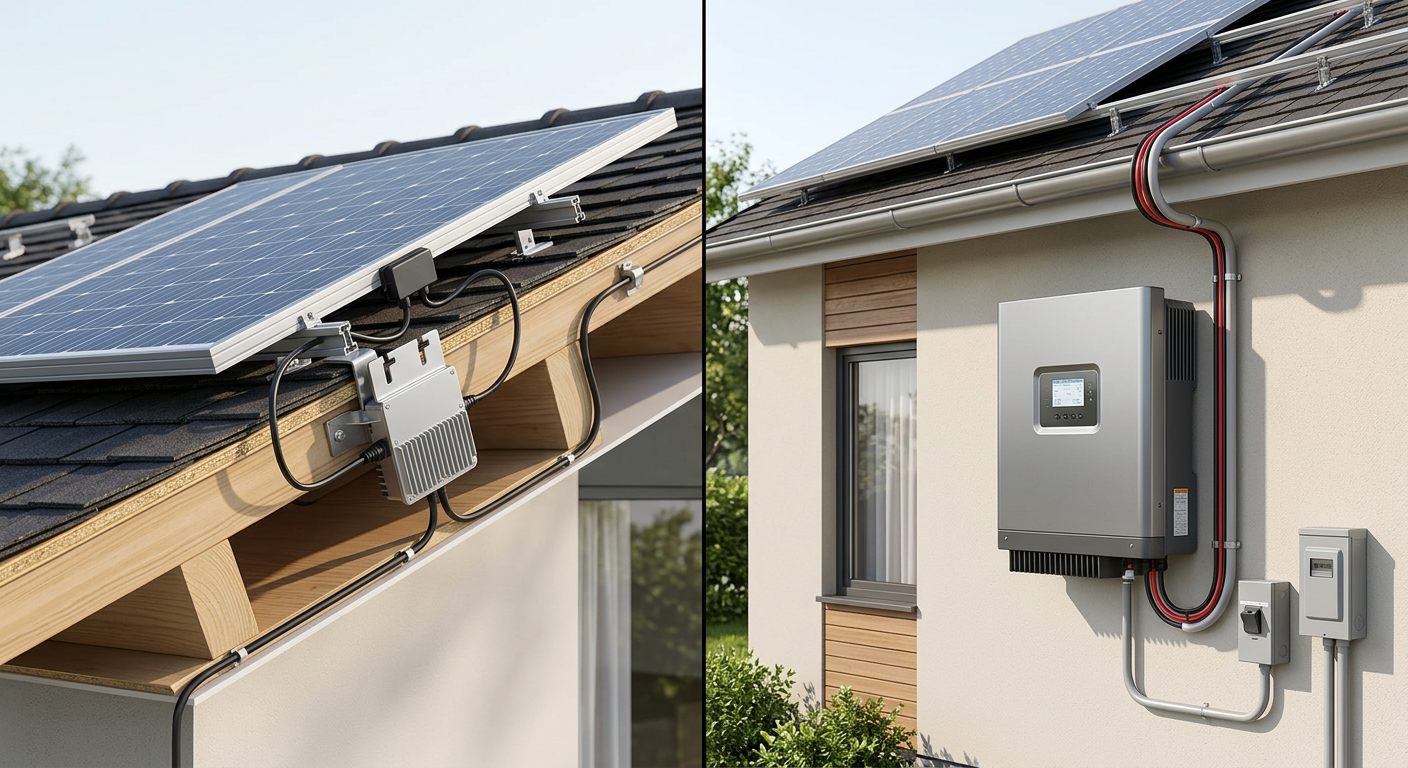
Optimizers vs. Microinverters
This is the most common comparison homeowners face. Both technologies solve the same fundamental problem — panel-level mismatch and shade losses — but they do it differently.
Key Differences
| Feature | SolarEdge Optimizers | Enphase Microinverters |
|---|---|---|
| Conversion | DC-to-DC (needs string inverter) | DC-to-AC (no string inverter) |
| Single point of failure | Yes (string inverter) | No |
| Warranty | 25 yr (optimizer), 12-25 yr (inverter) | 25 yr (everything) |
| Shade performance | Very good | Excellent |
| Monitoring accuracy | Modeled (DC measurement) | Direct (AC measurement) |
| Expansion ease | Moderate (string constraints) | Easy (any number of panels) |
| Cost | Lower | Higher |
| Backup without battery | No | Yes (with IQ System Controller) |
For most residential installations, we recommend Enphase microinverters for the reasons detailed in our microinverters vs. string inverters comparison. However, SolarEdge optimizers remain a solid choice, especially when:
- Budget favors the lower-cost option
- DC-coupled battery storage is desired (SolarEdge's DC coupling is slightly more efficient)
- The homeowner prefers SolarEdge's monitoring platform
- The system is large enough to benefit from centralized conversion efficiency
Optimizer Reliability and Lifespan
SolarEdge optimizers carry a 25-year warranty, matching the panels they are attached to. Real-world failure rates are low — SolarEdge reports less than 0.1 percent annual failure rates for their optimizers.
The string inverter is the more reliability-sensitive component. SolarEdge's residential inverters have a standard 12-year warranty (extendable to 20 or 25 years for an additional fee). If the inverter fails outside warranty, replacement costs $1,500 to $3,000 including labor.
This is the key reliability difference versus microinverters: a single inverter failure takes the entire system offline, while a single microinverter failure only affects one panel. For most homeowners, the financial impact is identical (both are warranty-covered), but the downtime risk differs.
Tigo Optimizers: The Alternative
Tigo is a smaller optimizer manufacturer that offers a different approach. Their optimizers can be paired with any string inverter brand — not just their own — making them a retrofit option for existing string inverter systems that need shade mitigation or monitoring.
Tigo also offers "selective deployment," where you only install optimizers on panels that actually have shading issues. This reduces cost compared to SolarEdge's requirement that every panel in the system have an optimizer.
The downside is a smaller support network and less seamless integration compared to SolarEdge's all-in-one approach.
Colorado Considerations
Colorado's housing stock presents several scenarios where optimizers earn their keep:
Mountain homes often have complex rooflines with multiple orientations and tree shading. Optimizers or microinverters are essential for these installations.
Front Range neighborhoods with mature trees can have significant shade, especially as trees continue to grow during the system's 25-year lifespan. An installation that is shade-free today may have shade in 10 years.
Snow clearing. When snow melts unevenly across a roof, some panels clear before others. With optimizers, cleared panels produce at full output without being dragged down by snow-covered panels in the same string.
Altitude performance. Colorado's high altitude means more intense solar radiation. Optimizers help each panel track its optimal operating point across varying intensity levels throughout the day, maximizing the benefit of our exceptional solar resource.
For more on how Colorado's unique conditions affect solar production, see our guide on solar performance in Colorado's climate.
Our Recommendation
If you are choosing between a basic string inverter and a SolarEdge optimizer system, the optimizer system is almost always worth the modest cost premium. The shade mitigation, monitoring, and code compliance benefits make it a smart investment.
If you are choosing between SolarEdge optimizers and Enphase microinverters, the decision depends on your specific priorities. For most Colorado homeowners, we recommend Enphase microinverters for their superior shade handling, 25-year warranty with no inverter replacement, expansion flexibility, and sunlight backup capability. But SolarEdge remains an excellent choice, and we install both systems regularly.
Get Expert System Design
The right inverter and optimization technology depends on your specific roof conditions, shading, and energy goals. Use our solar calculator to start estimating your system, or call (303) 484-1410 for a free consultation. Our design team will evaluate your roof, model shade impacts, and recommend the optimal technology for your installation.